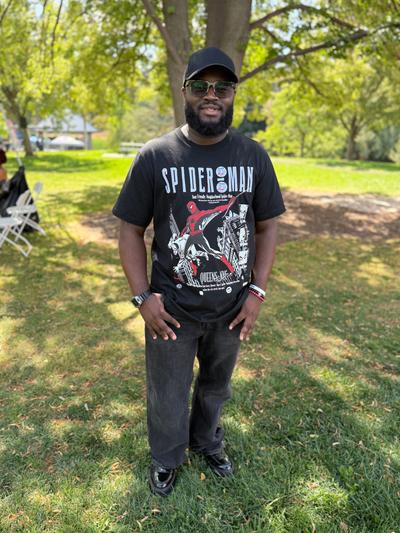
As wildfires forced thousands of Spokane-area residents to evacuate in early August, Elysee Kazadi faced the same uncertainty from his North Indian Trail home. Yet instead of focusing only on whether his own home would survive, Kazadi, an American Red Cross volunteer since 2020, went to work helping other evacuees. In this interview, Kazadi reflects on experiencing disaster firsthand, finding calm through service and why communities should not have to wait for tragedy to come together.
Q: Tell me about your experience with the recent wildfire. Which fire impacted you?
Kazadi: I live in North Indian Trail, so they are calling it the Spokane Complex Fires. I was evacuated, but I was at a coffee shop doing my stuff. Then my roommate called, and there was so much commotion going on that I couldn’t go back.
I have a Red Cross vest in my car, and I’m a Red Cross volunteer, so I decided to go. They have shelters they set up, so I was like, “Let me go and help set up the shelters so that people can see a familiar face, someone they know,” because sometimes they do deploy people from outside the local area. I was like, “Let me make myself useful.”
Q: When did you become a Red Cross volunteer?
Kazadi: That was during the pandemic because I was feeling the same thing again. I was like, people who look like me also go through disasters. So if I am there and there’s a familiar face, I can ease someone’s tension or things like that. So, since 2020.
Q: Were you worried about your house or your apartment?
Kazadi: At the moment when all this was happening, no. But after things were torn down, yes. Yes, because I was not in my house. I don’t have my clothes. I can’t imagine starting all over again.
Also, work continues. You still have a job to go to and everything else, so I was really worried.
Q: Can you explain the different emotions you felt? From what you just shared, you didn’t even go home. You went straight into volunteer mode.
Kazadi: Yes. So there’s so much emotion there. For me, running toward the people suffering and having a vulnerable moment, for me that was calming because it’s like I’ve also been in that place.
My way of giving out to the world, I’m not a billionaire, but my way of giving is volunteering. So I was like, let me give through volunteering.
Also worried because I’m thinking of the families that might be involved in all this, and also shocked that this is happening. We see this in movies, on TV or on the news, and it’s another thing being in the news and seeing what someone goes through every day, being in such a calamity.
Q: What message do you have moving forward? How do you have hope in a time like this where, like you said, life goes on, but a lot of lives have been interrupted?
Kazadi: My encouragement to people is, as much as the system has failed us, we have to go look at our insurance, look at all those things, talk to organizations. There’s people who know people that can help out.
Also, take time. Look for mental health help. You might think nothing happened to you, but something happened to you. It’s just not registering right now.
Another thing is to stay hopeful. We now know that disasters don’t choose parties, whether you are red or blue or purple. And so let us work on our goals to help each other unite and stop all this division.
We don’t need a disaster to unite us. We can always be united.