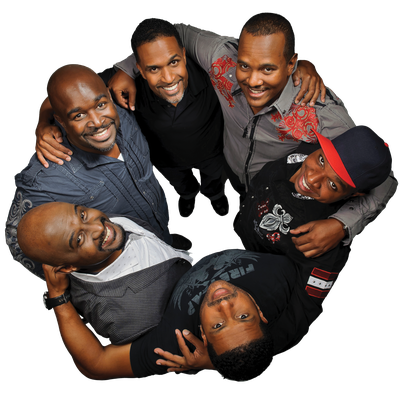
The Black Lens presents a conversation and reflection centered on legacy, excellence, and the unifying power of music. This feature highlights Take 6, whose sound has shaped generations, through both dialogue and live experience.
I had the opportunity to sit down with Claude McKnight, co-founder of Take 6 and a ten time Grammy Award winner. Reflecting on the group’s beginnings at Oakwood University in 1980, what started as a small a cappella group rooted in barbershop harmony quickly evolved into something distinct. With the addition of more voices, the group expanded into rich, jazz influenced arrangements that would ultimately define their signature sound.
Their foundation, however, was never just musical. The church played a central role in shaping not only their sound, but their identity. Raised in musical families and grounded in faith, each member brought a depth that extended beyond performance into purpose.
When asked about preserving the legacy of a cappella music, the answer was simple: love. The group does not approach preservation as an obligation, but as a passion. Through that passion, the tradition continues.
Harmony, as they describe it, is more than sound. It is a model for life. It requires listening. It requires cooperation. Even in moments of disagreement, there remains a path forward when people are willing to hear one another.
That same philosophy carries into their live performances. No two shows are ever the same. A cappella, in its purest form, creates a living, breathing experience that cannot be replicated in a studio recording. Each performance becomes its own moment in time. The intention is clear: come with curiosity and leave feeling better than when you arrived.
Beyond the stage, their partnership with St. Jude Children’s Research Hospital reflects a deeper commitment rooted in compassion, healing, and service. For a group whose music touches the soul, their mission extends far beyond it.
Take 6 demonstrated a rare ability to make multiple voices sound like one while still allowing each individual voice to shine with clarity and excellence. Their musical arrangements, cohesion as a unit, and seamless transitions reflected precision at the highest level.
A standout moment of the evening was their radiant rendition of “Homeless,” honoring Paul Simon alongside the influence of Ladysmith Black Mambazo. The performance carried both cultural depth and emotional weight.
Individual performances by Claude, Khristian, Alvin, and Mark showcased the group’s versatility. Each brought a distinct voice while remaining anchored in the collective sound.
The night was filled with themes of joy, love, and peace, brought to life through songs such as “Sailing” and their timeless 1988 hit “Spread Love.” Tributes extended across generations, including music from Stevie Wonder, Ray Charles, and Woody Guthrie with “This Land Is Your Land.”
The audience connection was powerful and immediate. Through call and response, clapping, and shared energy, the experience became interactive and alive.
Emotionally, the night resonated deeply. Supported by strong acoustics and clear sightlines, the setting at the Myrtle Woldson Performing Arts Center allowed every note and moment to land with intention.
What unfolded was more than a concert. It was a musical journey centered on unity, hope, and the transformative power of the human voice.
In closing, the group left the audience with something lasting: a sense of belonging, a feeling of connection, and a reminder of what true harmony can create.
In every sense, this was pure music in its raw form. Life offers moments that stay with you. This was one of them. I am grateful to have witnessed it.
Special thanks to Beth Moore, Gonzaga University, Marketing Manager for the College of Arts and Sciences at the Myrtle Woldson Performing Arts Center.