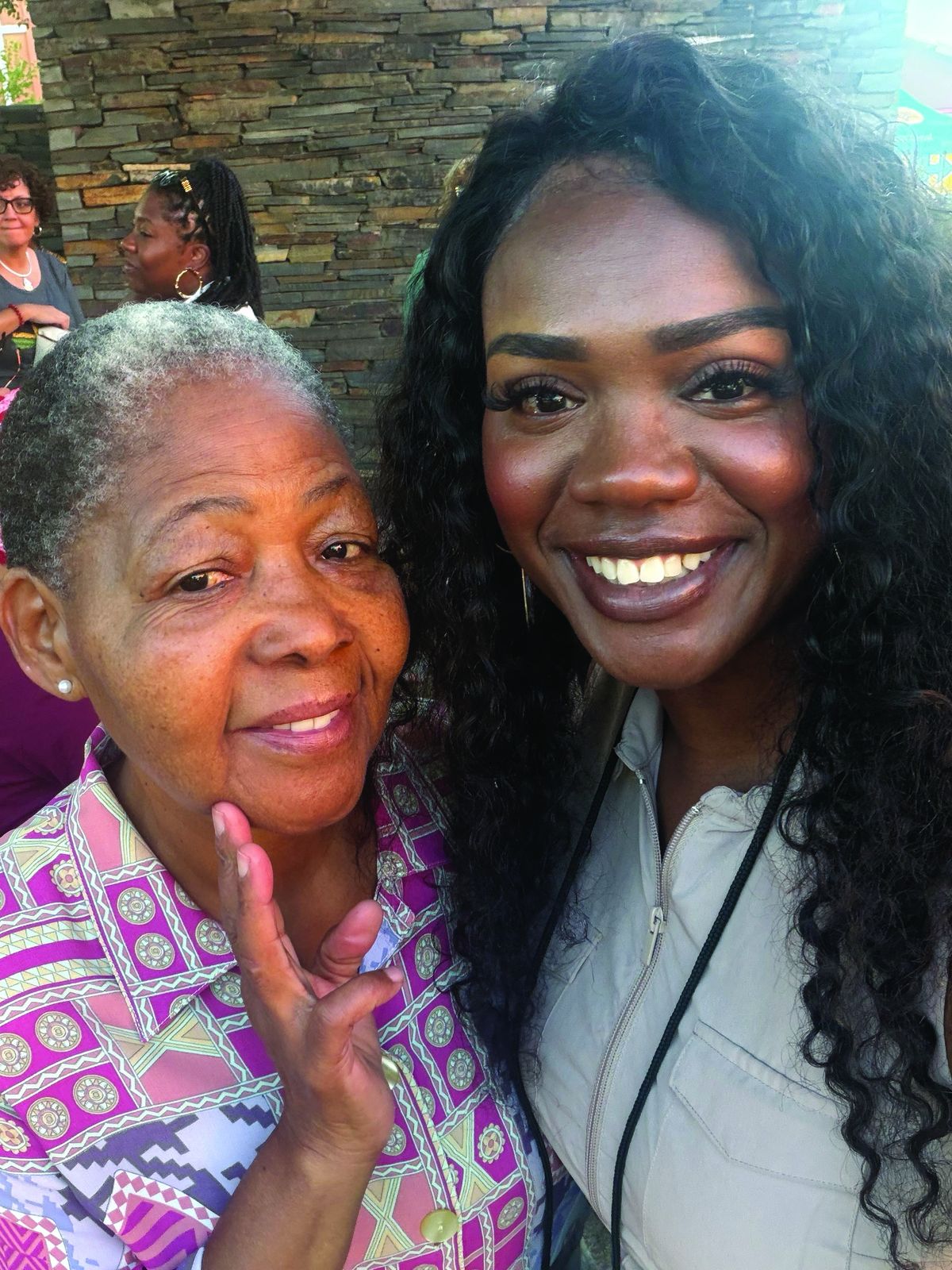
For Lisa Gardner, the journey to South Africa began with curiosity, uncertainty, and a quiet question many Black Americans carry: What does it mean to return to a place we have been told is home, but cannot fully trace? What unfolded, however, became something deeper, a journey toward understanding self, history, and the shared threads that connect the global Black experience.
Before the trip, even the possibility of going felt uncertain. Living with sickle cell, Gardner never imagined she would physically be able to make a journey of that distance. Simply arriving carried emotional weight.
Q: What were your first thoughts heading to South Africa, even just being on the plane?
Gardner: I never thought that I would be able to make a journey like that physically because of my sickle cell, so it was emotional from the beginning. I was thinking, one, I’m really about to go to Africa, and two, I hope I make it. I actually made it to Africa.
We landed in Cape Town, South Africa, where we spent about six days taking in the landscape, history, and cultural experiences. After that, we traveled to Johannesburg and spent another six and a half days there, which gave us a completely different perspective of the country, more urban, more fast paced, and more centered on everyday life and industry.
When I got there, I was in awe. I’m in Africa. I’m really here. That alone, before anything else, was powerful.
What began as travel quickly shifted into reflection.
Q: Did it feel like a pilgrimage?
Gardner: I feel like there were 33 of us who went, and we all went to the same continent, the same cities, the same hotels, but we all had different experiences in what we were expecting and what we experienced. For me, it was a complicated journey because I’m going as this Black American who has always been told falsehoods about Africa.
Being Black American, we are just told we’re from Africa. We don’t know what region, what tribe, or what country. So growing up, we just loved Africa. Africa is the motherland. We know that based on the color of our skin and the history of this country. Going to the continent itself was emotional.
In Cape Town, the experience was both spiritual and sobering. One of the most profound moments came at the edge of the Atlantic Ocean during a ceremonial gathering at sunrise. It offered a different kind of connection, grounded in presence, reflection, and the natural world.
Gardner: We got up at 5:00 AM and went to the Atlantic Ocean for a water ceremony. We wore all white. There was singing and chanting and drumming, and it was almost like a spiritual baptism. The water is bone cold, super cold. Some people were fully submerged. Some went waist deep. I only went to the ankles because it was too cold.
But it was so beautiful. You felt spiritual. I felt like I had made a life journey. My life has led me to this moment, watching the sun come up on the Atlantic Ocean in Africa, in Cape Town. It was beautiful.
That moment of connection stood in contrast to the harsh realities uncovered in historical sites.
Q: What did Cape Town show you?
Gardner: Cape Town is very “beachy”, very beautiful, with houses on the water. But when you get inland, that’s where you see poverty. You see the townships, more of the Indigenous people, and people who still speak their mother’s tongue.
We went to the Castle of Good Hope, and it showed a lot of colonialism, power imbalance, captivity, and torture. Then we went to Robben Island, where Nelson Mandela spent 18 of his 27 years. It was emotional, but it made me angry. These were political prisoners. They were against apartheid.
Johannesburg revealed a different layer of South African life, one that felt more urban and economically complex.
Q: How was Johannesburg different?
Gardner: Johannesburg is metropolitan. Think New York. It has skyscrapers, taxis, and millions of people. It was completely different from Cape Town. In Johannesburg, I saw much more professional, middle class Black people.
Cape Town felt more designed to be a tourist attraction and more colonized. Johannesburg felt more like a city where you could see Black professional life.
Across both cities, Gardner returned to a question that followed her throughout the trip, the difference between inherited identity and interrupted identity. In South Africa, she observed a sense of cultural certainty. People could name their lineage, language, and place with clarity. In contrast, her experience as a Black American reflected something more fragmented, shaped by histories that obscured origin and continuity. That contrast did not diminish identity. Instead, it deepened her understanding of it. It revealed how displacement, survival, and cultural creation have formed a distinct and powerful lineage of their own, even in the absence of clearly traceable roots.
Q: What did the experience teach you about identity?
Gardner: There was still a cultural divide. They know they are South African. They don’t have to guess what their heritage is. They know their true identity. We don’t really know our connection in the same way.
Black America has influenced the world through music, art, and culture. But Africans have this confidence because that is their country.
Ultimately, the trip expanded her understanding beyond geography. It revealed connections across continents and reinforced the importance of stepping outside familiar environments.
Q: Why is exposure beyond our own environment important?
Gardner: Because we don’t really know our true selves. We only know what we’ve been told.
Exposure is important because you see the similarities we have with other cultures. They want us separated because that is how they divide and conquer. Fear handicaps people and keeps people in a small space.
When you let go of that fear and explore, you see that you have more in common with other people than you think. Indigenous people in America, Africa, and South America, we are all one. We are the global majority, doing the same things in different places. That exposure is so rich. You cannot put a price tag on it.