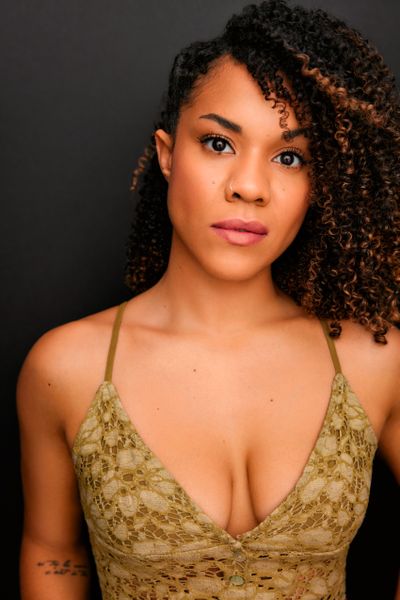
In “The Notebook,” actor Alysha Deslorieux plays Middle Allie, the version of the beloved character standing at one of life’s most consequential crossroads. In conversation with The Black Lens, Deslorieux reflected on art, identity, love, regret, and what it means for Black women to see themselves inside a story that is both specific and universal.
Q: Can you start by sharing where you’re from, how long you’ve been in theater, and a little about your role in The Notebook?
Alysha Deslorieux: I grew up in a suburb of Dallas, Texas, and I lived there until I was 18. I went off to college, and then I moved to New York when I was 22. I made my Broadway debut when I was 22 in “Sister Act.” That was back in 2012, so it’s been a long time.
I grew up singing and dancing, and I sort of got into theater when I was in high school. I really fell in love with the idea of being able to mix a lot of these different arts that I had studied as a kid into one venture. When I started with theater, it really connected me to what I wanted to do—getting to tell stories and still getting to sing, but also feeling like I had a purpose to it.
Q: Tell me about your character and what it means to play her.
Deslorieux: The main characters in the show are Noah and Allie, and we see her in three different stages of her life: Young Allie, Middle Allie, and Older Allie. I play Middle Allie.
What connects me most to this character is that she’s at a point in her life where she has a really big decision to make about how she wants to live going forward. I really remember that stage of my own life—turning 29, 30—and I feel like a lot of people have this transition period where they’re choosing to let go of things that are no longer serving them.
Her family means a lot to her. Her fiancé means a lot to her. But she still feels like there’s a part of her that’s missing, parts of her she’s not really getting to express. She doesn’t feel all the way full. In order to reach for those things, she has to leave behind some of the classic comforts of her life and the things everyone tells her are best for her.
Q: The story raises questions about women, duty and regret. What stands out to you there, especially for Black women?
Deslorieux: What’s interesting to me is that, in the beginning of the story, her mom is so careful to direct her life in a way that will protect her and also instill in her that she’s not going to get a second chance because she’s a Black woman.
A lot of the steps they take to guide her are about doing what they think is best: study Latin and French, take piano lessons, you can paint, but none of those things are serious, so make sure to marry a man with a lot of money. Of course, the man she eventually finds is well off, but she’s leaving behind the parts of herself that could lead her on a more unpredictable path—the things she really loves. She’s a painter. She wants to be an artist.
I don’t think she realizes how much of herself she is sacrificing for the idea of security and financial stability. She just knows that all of this protection is not serving her anymore.
Q: What does the show suggest about regret and the risk of choosing a fuller life?
Deslorieux: I have a pretty strong feeling that it’s kind of never too late to make a turn. If you’re living with regret and you’re able to make a change, I don’t think it’s ever too late, even if it’s scary.
If you know you’re going to spend your life regretting not having done something, or regretting having chosen what just felt safe, then it would be worth it to take a risk and choose another path. I don’t think it’s selfish to try and take your life by the reins instead of living with regret.
Because you don’t know what you don’t know when you’re young. You live and experience things, and then you realize what’s really important to you as you grow older.
Q: What moment in the show should audiences pay special attention to?
Deslorieux: One of my favorite moments in the show is a song called “I Want to Go Back.” We’re looking at Older Allie, and she’s really struggling. She has all these little puzzle pieces of memories from her life, and she’s trying to lace them back together.
Young Allie and I get to sing this song together—it’s the only time all three versions of Allie are onstage at the same time. It’s heartbreaking, but it’s also a reminder of all the things that make up a person’s life. It’s not just your one true love. It’s all of the friends and the family who make up who you are.
Q: How do you view the power of art?
Deslorieux: I find art to be far more than entertainment. I think it’s medicinal. It’s crucial and necessary because it cuts right to people’s depth. Theater reveals our inner emotions.
One of the reasons I love working on this show is that our co-director, Schele Williams, gave us this explanation of who Allie’s family was—an affluent Black community that actually existed in that time period. I didn’t even know it existed.
In our story, Allie is Black and comes from a well-off family. The idea that this could be a real story is much more important than just colorblind casting. It feels based in reality. And it’s not just about Black pain—it’s a universal story.
When I see young Black girls in the audience, I think about what it would have meant for me to see that—to see a version of myself onstage and immediately imagine it to be possible.
Q: What do you want your legacy to be?
Deslorieux: I just want to live a life surrounded by love and friendship and people that see me and understand me. I don’t have a desire to be famous. I want the freedom to live my life the way I want to.
And I think about the women who came before me. I really hope that I am making them proud and finding joy in ways that they were not able to.
For Alysha Deslorieux, playing Middle Allie ultimately becomes less about the decision itself and more about what it reveals. At its core, The Notebook invites audiences to consider what it means to live fully—and honestly—within the life you claim as your own.
Through her portrayal, Deslorieux asks us to sit with that tension: the weight of expectation, the cost of self-abandonment, and the courage required to choose differently. For Black women in particular, that choice exists within a legacy shaped by survival and sacrifice.
What lingers is not simply the love story, but the possibility—that choosing yourself is not a betrayal of what came before, but an extension of it.