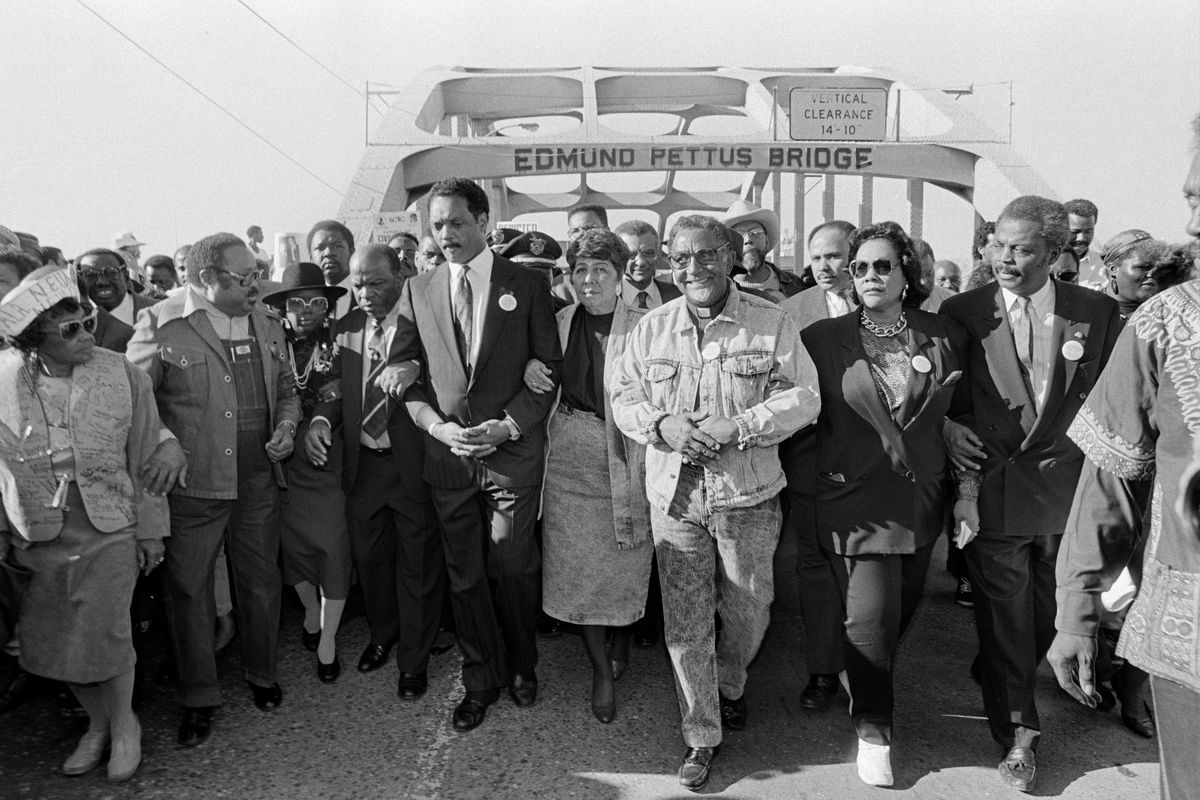
On Feb. 17, the nation pauses to honor the life and legacy of Jesse Jackson, an American icon whose voice shaped movements, elections, diplomacy, and generations of hope. For more than six decades, Reverend Jackson stood at the intersection of faith and freedom, preaching not only from pulpits but from podiums, picket lines, and presidential stages. His journey stretched from the segregated South to global diplomacy, marked by conviction, controversy, courage, and an unwavering belief in justice.
Born Oct. 8, 1941, in Greenville, South Carolina, Jesse Louis Burns entered a nation divided by law and custom. After being adopted by his stepfather, Charles Henry Jackson, he carried the Jackson name into history. Even in his youth, he exhibited an uncommon presence: athletic, articulate, and deeply aware of the racial barriers surrounding him.
Scripture reminds us in Jeremiah 1:5, “Before I formed thee in the belly I knew thee; and before thou camest forth out of the womb I sanctified thee.” Many who observed Jackson’s life believed his calling was evident early. His destiny would be rooted in ministry and movement.
Jackson attended the University of Illinois before transferring to North Carolina A&T State University, where he thrived as a student leader. His path changed in 1965 when he joined the Southern Christian Leadership Conference and became a protégé of Martin Luther King Jr. Under Dr. King’s mentorship, Jackson sharpened his organizing and oratorical skills. He was present in Memphis on April 4, 1968, when Dr. King was assassinated, a tragedy that deepened his commitment to carry the movement forward.
In 1971, he founded Operation PUSH, later expanding it into the Rainbow PUSH Coalition. PUSH blended protest with policy, urging corporations to hire Black executives, contract with minority-owned businesses, and invest in underserved communities. Jackson believed that civil rights without economic rights left freedom incomplete.
His message echoed the words of Micah 6:8: “He hath shewed thee, O man, what is good; and what doth the Lord require of thee, but to do justly, and to love mercy, and to walk humbly with thy God?” Justice, mercy, humility, these themes defined his preaching and activism.
By the 1980s, Jackson stepped onto the national political stage. In 1984 and 1988, he ran for President of the United States, becoming the first African American candidate to build a viable campaign within a major political party. His “Rainbow Coalition” united African Americans, working-class whites, Latinos, Native Americans, labor unions, and farmers under a shared vision of opportunity and equity. His rallying cry, “Keep Hope Alive,” became one of the most enduring phrases in American political culture, paving the way for future leaders and expanding the nation’s democratic imagination.
Beyond domestic politics, Jackson became a global humanitarian. He negotiated the release of American prisoners in Syria and Cuba during the 1980s and advocated for the dismantling of apartheid in South Africa. He entered rooms others could not and spoke where diplomacy had stalled.
Yet his life was not without imperfection. In the early 2000s, he publicly acknowledged an extramarital affair that resulted in the birth of a daughter. The revelation wounded his public image. Still, he addressed the matter openly and returned to public service, continuing his advocacy through Rainbow PUSH and mentoring younger activists. His response reflected the truth of Romans 3:23, “For all have sinned, and come short of the glory of God.” Accountability and continued service marked that chapter of his journey.
Jackson’s legacy is defined not merely by speeches but by presence. He stood with the Jena Six in Louisiana when racial tensions reignited national attention. He crossed the Edmund Pettus Bridge in Selma, Alabama, honoring the legacy of Bloody Sunday. Even as Parkinson’s disease slowed his body, he remained spiritually steadfast, appearing as recently as 2022 to inspire new generations to continue the work.
Through decades of change, Jackson registered millions of voters, challenged corporations toward accountability, pressed for educational access, and demanded economic justice. He moved comfortably between church sanctuaries and convention halls, protest lines and diplomatic missions. He remained, at heart, a preacher shaped by the Black church tradition: rhythmic, passionate, and uncompromising in hope.
Reverend Jesse Louis Jackson, Sr., moved people toward courage. He moved systems toward justice. He moved nations toward dialogue. He was not perfect, but he was present. Not flawless, but faithful.
Today, America reflects on a life that helped bend the arc of history. His message still echoes across generations, rooted in faith and fueled by perseverance.
“Keep hope alive.”