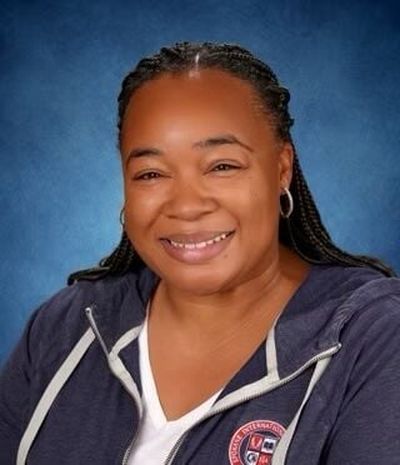
For generations, leadership in public education has been shaped by narrow ideas of who holds authority, whose voice carries weight, and what power looks like in schools. Women–particularly Black women–have long done the labor of teaching, counseling, and caretaking, while decision-making authority has often remained elsewhere. At Spokane International Academy, Principal Morgen Flowers quietly and consistently disrupts that tradition–not through spectacle, but through presence, systems, and trust.
“I think my presence matters in a lot of ways because it expands what feels possible for students and families,” Flowers says. “In many ways it’s sort of a quiet challenge to why narratives are limited about who leads and who gets to decide what happens and whose voice carries weight in educational spaces.”
Flowers’ leadership is deeply rooted in Spokane. She first arrived in 1998 to attend Gonzaga University, later returning for graduate school and building a career that spans teaching, counseling, and administration. She holds degrees in English literature, school counseling, teaching, and educational administration–not, she explains, as an academic flex, but because each credential was necessary to do the work she felt called to do.
“It wasn’t that I set out to do that,” she says of earning four degrees. “I needed each of the degrees to do the job that I wanted to do, so I had to keep going.”
As a Black woman leading a public charter school, Flowers understands representation not as symbolism, but as lived experience–especially for students who rarely see authority embodied in someone who looks like them.
“For students, especially students of color, it can affirm leadership. It can affirm intellect and compassion, and what authority can look like for them,” she explains. “But for families, a lot of times it just builds trust that their lived experiences are understood.”
That trust shows up in unexpected ways. Each year during Principal Appreciation Day, students draw pictures of their school leader.
“When they draw a principal, they draw a Black lady,” Flowers says with a laugh. “They don’t know any other way to be a principal, because that’s all many of them have known since kindergarten.”
That normalization matters–not only for Black students, but for everyone in the building. Flowers is clear that representation is not a niche concern.
“It’s important for Black students, but it’s important for every other student as well,” she says. “To have that perspective.”
Spokane International Academy serves students from 13 ZIP codes across the region, reflecting a mix of racial, economic, linguistic, and learning needs. Flowers is direct about the reality of barriers.
“Barriers are real,” she says. “But just because they exist doesn’t mean that you have to completely stay within them. You can absolutely transcend what a barrier looks like, providing you have a team that’s savvy enough and cares enough about the community to problem-solve a response.”
At SIA, that response is rooted in relationships, data, and listening. The school pairs high expectations with intensive support, a philosophy Flowers frames as a matter of justice.
“High expectations are a social justice issue for me,” she says. “We don’t lower the bar for students because of their circumstance, their background, or perceived limitations. We’re going to raise our level of support.”
Charter schools often sit at the center of national debate, but Flowers resists false binaries that pit public systems against one another.
“This is not a competition,” she says. “It’s a shared responsibility. We’re a public school, and we should all be working toward the same goal–preparing students for meaningful futures.”
She is equally candid about misconceptions.
“One myth is that charter schools are selecting the students that we want, and that’s just simply untrue,” Flowers explains. “We’re enrollment-driven. We take who we receive, and we do our best to serve them with the resources that we have.”
Her commitment to school choice is personal as well as professional. As a parent, Flowers has made different schooling decisions for her own children based on fit, representation, and readiness–not ideology.
“Parents and kids should be able to choose what makes sense for their learning,” she says. “The goal is meeting kids where they are and understanding that learning is multifaceted for every child.”
When asked about her legacy, Flowers pauses. Like many women leaders, she is deeply embedded in the work, rarely afforded the distance to measure her impact in real time. Still, she is clear about what she wants future Black women educators to see.
“I want to model what it looks like to take up space unapologetically and to trust your voice and lead in authentic rather than performative ways,” she says.
She understands part of the challenge is structural. Decision-makers often default to what feels familiar.
“They want the sure thing,” Flowers explains. “That other thing–they’d have to take a chance on that. And people don’t always want to gamble.”
She continues to lead with integrity, transparency, and a deep belief in community.
“I try to ask, what is in the best interest of kids, and how do we move there responsibly?” she says. “Accountability matters because the public is trusting us with their children and their resources.”
For Flowers, leadership is not about occupying power, but about clearing barriers so others can thrive–particularly teachers.
“I actually became a school leader for teachers,” she says. “If I can hear their voices clearly, and they’re speaking on behalf of students, then if I help them, the students will get exactly what they need.”
During Women’s History Month, Morgen Flowers’ leadership offers a living reminder that history is not only something we commemorate–it is something we are actively shaping. In classrooms, hallways and decision-making spaces where Black women have too often been absent or overlooked, her presence quietly expands the future.
And for the students who draw a Black woman when asked to picture a principal, that future feels possible.
Want to learn more about enrolling at SIA? Visit spokaneintlacademy.org/enrollment.