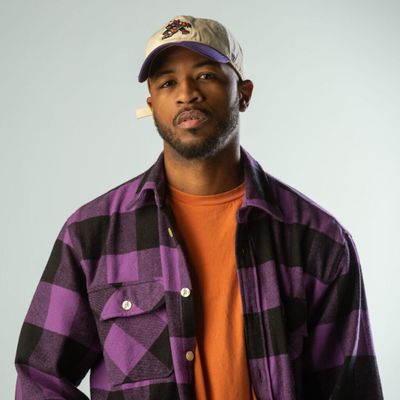
The Black Lens: Let’s start with your connection to Spokane. Did you grow up here, or did you move here?
Devonte Pearson: I moved to Spokane by way of Moses Lake around 2014. My wife and I both moved here for school. I attended Spokane Falls Community College for their audio engineering program and also finished my business management degree. I graduated with two degrees and have been navigating the art scene, primarily the music scene, since then.
Q: Are you a musician as well? What’s your skill set as an artist?
A: Yes, I’m a hip-hop artist and an audio engineer by trade. I’ve opened multiple recording spaces to provide services mainly for vocalists and some solo instrumentalists. The most recent space was Panoramic Dreams Recording. We had multiple rooms utilized by different artists for different parts of production including beat production, film production, vocal production, and even a meeting space. We hosted listening parties and ran an internship program connected to the studio for up-and-coming audio engineers.
Q: What is your role with Spokane Arts?
A: I’m the Program Director. I handle logistics and coordinate programming. We recently launched a Youth Poet Laureate program in partnership with Avista Foundation, Leadership Spokane, Spark Central, and our current Poet Laureate. I create the call, design the posters, send out press releases, and coordinate everyone involved. I’m engaged in every facet of programming.
Q: How long have you been with Spokane Arts?
A: I joined in spring of 2024 as Operations Manager. Since October 2025, I’ve been the Program Director.
Q: A lot of young people want to be entertainers, but there are so many roles within the entertainment industry that they might not know about. Can you talk about audio engineering as a career option?
A: Absolutely. Audio engineers are usually the people you see behind the board operating sound for live venues or recording studios. They work with software like Pro Tools or Logic Pro to record vocals and instruments. I went down the path of audio engineering because I needed to record myself as an artist. I’m a big advocate of becoming what you need. If you don’t have access to engineers, beat makers, or filmmakers, learn those skills yourself.
School, especially community college, was a great way for me to do that. I didn’t know anybody when I moved here. I knew one person. I met the community through school projects and started doing shows. The first place I promoted myself as an artist was at the college, hanging posters there. For anyone wanting to thrive in the industry, look at the roles that need to be filled and see if you can fill them starting out. You can learn almost anything now through YouTube, online forums, Google, or AI. I still engineer my own music and direct my own visuals when needed.
Q: Let’s pivot to arts and identity. Why are the arts so significant, especially in a place like Spokane?
A: You can’t quantify art. You can teach technical skills, but art is culture. You can tell someone about culture, but to experience it is different. We get to know different cultures through music and fashion.
In a space like Spokane, where I don’t always see myself reflected, it’s easy to get lost and conform to the dominant culture, losing connection to family and ancestors. That harms the next generation because we lose our ability to speak across generations.
Art allows expression in multiple mediums such as drums, film, and poetry. Poetry isn’t boxed in by tempo or production. It’s just voice. Seeing ourselves on the big screen drives hope, resilience, and ambition. Words can only do so much, but art provides blueprints for how to carry yourself, how to dress, and how to navigate a room. It’s not a mathematical equation. It’s expression, and expression is infinite.
Q: Let’s talk about conformity. What role does it play in shaping identity and how we navigate society?
A: I’m a Black man in Spokane, often the only one in certain rooms. Conformity can set unattainable standards. Growing up, speakers would come dressed in suits and expensive shoes. On one hand, it was aspirational. On the other hand, it felt inaccessible.
When my business partner and I enter rooms, we carry ourselves confidently and authentically. Young brothers once told us they appreciated that because it gave them confidence to enter more spaces. Conformity can create barriers by suggesting you can come in only if you meet certain expectations. It sets standards without showing the steps to get there. Show us level one before expecting level ten.
We care about how we present ourselves, but we don’t use a filter from people who can’t relate to us as a barometer for how we dress or carry ourselves. Authentic expression is key.
Q: What legacy do you want to leave for young people coming behind you?
A: Integrity. Learn yourself before trying to learn the world. Understand how you operate. Have standards. Put yourself first because you cannot please the world. It’s impossible. Everything starts with self-care. Knowledge, morality, and how you carry yourself all follow.
Legacy is huge for me. If I leave anything, I hope it’s a blueprint rooted in integrity, passion, and authenticity.