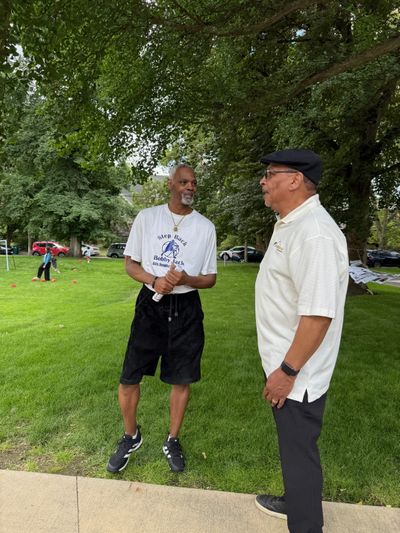
There is a humble spirit about Bobby Jack Sumler that makes him a force of unpretentious motivation and inspiration.
While many know him as “Step Back Bobby Jack,” a Spokane basketball legend, Hoopfest Hall of Famer, and Spokane Community College record-holder, the heart of his story runs much deeper than basketball. His journey is one of perseverance, faith, discipline, and an unwavering belief that no one else gets to define your future. Today, that lesson drives his work through the Step Back Bobby Jack Foundation, youth basketball camp, and scholarship efforts.
Sumler arrived in Spokane from Baton Rouge, Louisiana, in 1973.
“My mom and dad told us we were moving to Washington,” he recalled with a laugh. “We had never heard of Spokane. We thought we were moving to Washington, D.C.”
Basketball entered his life in junior high, but his path was far from easy. After playing at Libby Junior High, some coaches told him they did not believe he was good enough to play at the next level.
Instead of quitting, Sumler went to work.
His freshman year at Lewis and Clark High School, he did not play basketball. Instead, he and his brother spent countless hours at Liberty Park.
“Every day, me and my brother would go down to Liberty Park and practice,” Sumler said. “We stayed down there until almost nighttime. My brother rebounded for me, passed to me, did drills with me, and always encouraged me.”
His mother encouraged him too. A former point guard, she urged him to try out for the team despite his doubts.
“My mom was a point guard,” he said. “Back then they didn’t play full-court basketball. They played half-court.”
More importantly, she believed in him.
“She believed I could play even when I wasn’t sure.”
The following year, Sumler tried out for the Lewis and Clark team. When the roster was posted, he walked over to look.
“The first name on the list was mine,” he said. “I couldn’t believe it. From that point on, it was history.”
Looking back, Sumler credits much of his success to people who saw something in him before he saw it in himself.
“Bob Scott was my first coach, and he had a huge impact on my life,” he said. “Coach Scott saw something in me. My mom saw something in me. My brother saw something in me.”
Those early supporters shaped a philosophy that still guides him today.
“Sometimes a young person just needs somebody to believe in them,” he said. “When somebody sees something in you before you see it in yourself, that can change your life.”
By his senior year, Sumler had become one of the area’s top players and believes he was the first African American athlete to win the Greater Spokane League scoring title in 1979.
After graduation, his father became ill, and Sumler postponed college plans to help care for him. Eventually, while playing recreational basketball, he caught the attention of a coach from North Idaho College, who encouraged him to pursue college basketball and offered him a scholarship.
What should have been a promising opportunity became one of the most difficult experiences of his life.
“Basketball-wise, it was a great opportunity, but I also experienced racism that changed my life,” Sumler said.
One evening, while sitting in a McDonald’s drive-thru with teammates, Sumler encountered individuals connected to the Aryan Nation. Racial slurs were directed at the group, and one individual displayed a firearm.
“We couldn’t move forward or backward, so we just sat there,” he recalled.
A few days later, someone placed a stick of dynamite on the roof where he was staying.
“After that, I came home.”
The experience could have ended his basketball journey. Instead, it strengthened his resolve.
“I wasn’t going to let that define me,” he said.
Encouraged by his friend Steve Esthers and coaches at Spokane Community College, Sumler transferred to SCC and continued playing.
“They believed in me.”
At Spokane Community College, he rebuilt. In 1984, he recorded 157 steals in a single season, a school record that still stands today.
More importantly, he gained clarity about who he wanted to be.
“They taught me that you can’t let other people dictate who you are,” Sumler said. “People are always going to have opinions. Some people will doubt you. But they don’t know what’s inside of you.”
His advice remains simple and powerful.
“If you let somebody else determine your future, you’ll never know what you’re capable of. You have to believe in yourself before anybody else believes in you.”
That mindset carried him through decades of basketball, including a place in Spokane’s Hoopfest history.
When Hoopfest began in 1990, there was no Elite Division or Open Division structure. Sumler played during the tournament’s formative years and helped establish a standard of excellence that became part of Hoopfest lore.
In 1991, he teamed with Randy Smith, Arnold Brown, and David Peed to win the championship. The following year, in 1992, he returned alongside Randy Smith, Dexter Griffin, and Kemo Patrick to capture the title again.
“When I first played, there were only about 532 teams,” he said.
Today, Hoopfest attracts thousands of participants from around the world, but Sumler believes its importance goes beyond basketball.
“It’s bigger than basketball,” he said. “It brings people together. Families come together. Friends come together. Communities come together.”
That same spirit drives the Step Back Bobby Jack Foundation and free youth basketball camp for children ages 5 to 12.
“A lot of kids need encouragement,” he said. “They need somebody to believe in them. They need somebody to help them understand that where they start isn’t where they have to finish.”
The camp emphasizes basketball fundamentals, discipline, consistency, patience, and self-belief. Scholarships are also part of the effort, helping young people understand that education matters and that their community is willing to invest in their future.
As the interview winds down, Sumler pauses, overcome with gratitude for the life he has built in Spokane. He never set out to become one of the greatest ball players in Spokane. It is a legacy not built on accolades alone, but on the encouragement of family, mentors who believed in him, and a personal commitment to growth when others doubted his potential.
By his own admission, Sumler has never been one to seek the spotlight. Yet in one of the interview’s most vulnerable moments, he recalls receiving the call informing him that he would be inducted into the Hoopfest Hall of Fame. He remembers leaving the grocery store to share the news with his mother and sister, still trying to process what the honor meant, barely able to get the words out.
For a man who was once told he wasn’t good enough, who endured racism and intimidation while pursuing his dream, and who spent decades pouring into young people without seeking recognition, the moment carried a profound weight.
Still, even when reflecting on personal accomplishments, Sumler’s focus returns to service.
His voice softens, filled with humility and fulfillment.
“God has been good to me. I’ve been blessed, and I want to be a blessing to others. That’s what it’s all about. If you can help somebody else along the way, then you’ve done something worthwhile.”
In the end, that may be Bobby Jack Sumler’s greatest achievement—not the points scored, the championships won, or the records that still stand, but the lives he continues to impact by reminding others of the lesson that shaped his own journey: never let anyone else dictate who you are.