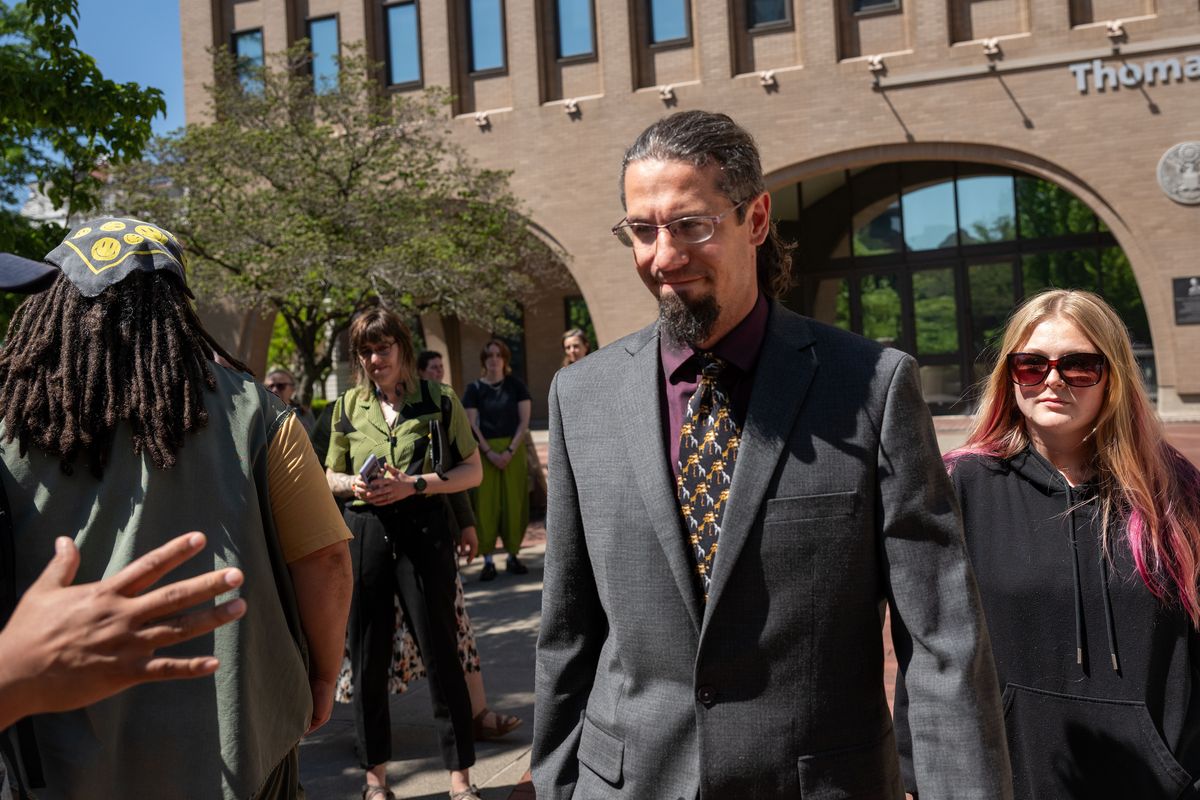
The guilty verdicts against Jac Archer, Justice Forral, and Bajun Mavalwalla II should concern anyone who values the First Amendment, community organizing, and the right to stand up against injustice.
After a week of testimony, a federal jury convicted The Spokane 3 on conspiracy-related charges stemming from a June 2025 protest opposing the detention of two Venezuelan asylum seekers. Notably, however, the jury did not convict any of the defendants of conspiracy to injure a federal officer—one of the government’s most serious allegations.
Throughout the trial, prosecutors argued that actions such as linking arms, organizing demonstrators, directing crowds, and engaging in civil disobedience were evidence of a criminal conspiracy. Defense attorneys countered that the government had failed to prove any agreement to commit crimes and instead presented evidence of protest activity, mutual aid, and constitutionally protected political expression.
As RANGE Media documented throughout the proceedings, defense attorneys repeatedly emphasized the absence of evidence showing an actual agreement to use force against federal officers. Attorney Aine Ahmed argued that sharing political beliefs or attending the same protest does not make individuals co-conspirators. Attorney Andrea George contended that the government stitched together independent actions and portrayed them as a coordinated criminal enterprise. Carl Oreskovich emphasized that Jac Archer’s role was to encourage nonviolence and help organize demonstrators in ways intended to keep people safe.
The testimony of the defendants painted a picture that differed significantly from the government’s narrative.
Mavalwalla testified that he attended because of his commitment to refugees and asylum seekers and his belief that people have a responsibility to speak out when they witness injustice. He stated that he knew virtually no one at the protest before arriving and denied any intent to block transportation or engage in violence. Archer’s defense argued that they arrived intending to participate in nonviolent civil disobedience and repeatedly encouraged demonstrators not to respond with violence, even during confrontations with law enforcement.
The government, meanwhile, asked jurors to interpret actions such as linking arms, standing together at a gate, organizing legal support, collecting emergency contacts, distributing supplies, and encouraging participation as evidence of conspiracy.
That interpretation carries implications far beyond this case.
From the Civil Rights Movement to Black Lives Matter, from labor organizing to immigrant-rights advocacy, social progress has depended on ordinary people organizing collectively to demand change. Throughout American history, authorities have often portrayed organizers as threats, agitators, or criminals. The Spokane 3 case raises concerns that protest itself may increasingly be viewed through a criminal lens when it challenges state power.
The trial also raised questions about the conduct and credibility of some government witnesses. Reporting revealed social media posts attributed to an ICE officer who testified in the case that contained derogatory remarks about transgender people and a Black elected official. Even prosecutors reportedly described the posts as “horrendous,” raising legitimate concerns about bias and accountability.
Despite those concerns, and despite testimony emphasizing nonviolence, the jury returned guilty verdicts on conspiracy-related charges.
The consequences extend beyond three defendants. The case may be cited in future prosecutions involving community organizers, immigrant-rights advocates, labor leaders, environmental activists, and others engaged in collective action.
The larger question remains: If organizing a protest can become conspiracy, what protections remain for speech, assembly, and political association? For many organizers, The Spokane 3 case is not simply about three individuals. It is about whether Americans can exercise their constitutional rights without fear that advocacy, association, and collective action will be redefined as criminal conduct.
THE VERDICT
On May 28, 2026 Jac Archer, Justice Forral, and Bajun Mavalwalla II were all found guilty on conspiracy-related charges.
Archer was convicted of conspiring to prevent a federal officer from performing official duties, conspiring to damage an officer’s property to impede those duties, and aiding and abetting a conspiracy to impede or injure officers.
Forral was convicted of conspiring to prevent a federal officer from performing official duties, conspiring to damage an officer’s property because of those duties, conspiring to damage an officer’s property to impede those duties, and aiding and abetting a conspiracy to impede or injure officers.
Mavalwalla was convicted solely of aiding and abetting a conspiracy to impede or injure officers.
None of the defendants were convicted of injuring a federal officer.
The convictions carry a maximum penalty of six years in federal prison and fines of up to $250,000. Appeals are planned for all defendants.