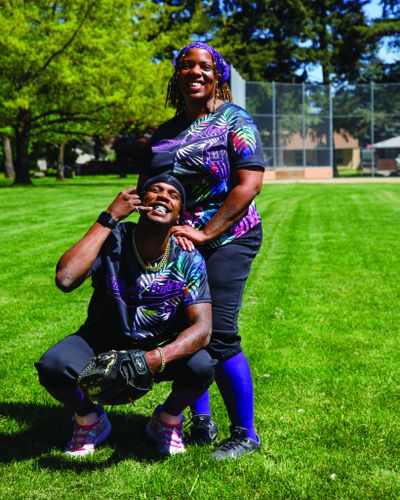
What began as a love for recreational softball quickly evolved into something much bigger for Pamela and Argne Henry: a vision for building community, connection, physical wellness, and visibility for Black Spokane through recreation and culture. The Atlanta transplants recently launched the Blackout Ballers, an all-Black slow-pitch softball team designed not only to compete, but to create a space where Black families, youth, adults, and newcomers can gather, build relationships, stay active, and experience joy together.
For the Henrys, physical fitness is not separate from community building. Through softball, they hope to create spaces centered on movement, teamwork, mental wellness, support, and belonging while encouraging Black residents to connect with one another in healthy and affirming ways. The Blackout Ballers represent more than a team; they reflect a growing desire for intentional community spaces where recreation becomes a pathway to solidarity, visibility, and collective well-being.
In this conversation with The Black Lens, the Henrys discuss Black community in Spokane, narrative control, recreation, physical health, and the importance of creating what you do not see.
What began as a love for recreational softball quickly evolved into something much bigger for Pamela and Argne Henry: a vision for building community, physical wellness, and connection for Black Spokane through recreation and culture.
The Atlanta transplants recently launched the Blackout Ballers, an all-Black slow-pitch softball team designed not only to compete, but to create a space where Black families, youth, adults, and newcomers can gather, stay active, and experience joy together. What started as a recreational activity has become a larger conversation about visibility, belonging, narrative control, and the power of creating what you do not see.
In this conversation with The Black Lens, the Henrys discuss building Black community in Spokane, the importance of recreation and physical fitness, and why spaces centered around connection still matter deeply.
Q: What inspired you to create the Blackout Ballers?
Pamela Henry: About five or six years ago I started playing softball recreationally for the City of Spokane. Last year specifically, my husband and I played on a team that was all Hispanic. They were a lovely bunch of people, and I saw that and said, “We need a team. Something for the community, something for the culture.”
As soon as I printed out the flyers looking for 11 people, I hadn’t even had the ability to put the flyers out yet and the spaces were already full. That showed me there was a need for it.
Q: What has it been like finding Black community in Spokane?
Pamela Henry: I had to make sure I got out in Spokane, and that’s how I started meeting people and building connections so I could build this team. Judy and Yashonda have a Zumba group on Mondays and Thursdays, and I started meeting people there. Those people kept telling me, “Go to this event. Go to that event.”
Every time I went somewhere, I met more people. It takes getting outside your comfort zone and being willing to connect.
Q: What does it mean to create an all-Black team in Spokane specifically?
Argne “Nay” Henry: It feels good that my wife put this together for us as the Black community. We want to make being Black, being together, and being on a team something beautiful to look at.
A lot of times people only hear negative narratives about Black communities. We want to change that narrative. We can be constructive, productive, healthy, intelligent, collaborative people.
We’re not saying we’re better than anybody else. We just want support and solidarity from people that look like us too.
Q: It sounds like this is bigger than softball.
Argne Henry: Absolutely. This is about learning how to collaborate and support one another. You can’t win a team activity by yourself. You have to rely on people, and they rely on you.
We want people to understand that if what you need is not out there, go out there and create it. We want kids and families to come out and feel comfortable, connected, and seen.
Sometimes people just need an outlet. Sometimes people need community. Sometimes they just need somewhere healthy to belong.
Q: Recreation and physical activity seem central to your vision. Why?
Pamela Henry: Physical activity is an amazing way to connect. We also joined a local boxing gym, and that’s another phenomenal connection. Recreation creates community.
Argne Henry: Mental health is real. Sometimes you just need to go out there and sweat a little bit. Maybe you need to move your body. Maybe you need teammates you’ve struggled with, sweated with, trained with.
That support matters.
I took a class once called the psychology of play, and it talked about how people learn and retain information better when things are gamified. Recreation gives people incentive, joy, reward, and connection.
There’s nothing wrong with being happy and smiling.
Q: What role does narrative control play in this work?
Argne Henry: It’s important for us to control our narrative because then it’s not somebody else telling our story from their viewpoint.
People have all these stereotypes about Black people, but we’re trying to turn that narrative around. We’re not lazy. We’re not just surviving. We can build, organize, support each other, and create beautiful things too.
My wife is bringing that spirit out in people. Every time she talks to somebody they light up.
Q: Spokane is not often thought of as a center of Black culture. What would you say to people who don’t realize Black community exists here?
Pamela Henry: It’s well worth going out there and finding it. Spokane may not look like Atlanta or Washington, D.C., but there is culture here. There are people here building things.
And if you don’t find the community space you need, there’s nothing wrong with creating it yourself.
Q: What do you hope the Blackout Ballers become?
Pamela Henry: I want kids to come out and see people who look like them. I want families out there. I want joy.
Argne Henry: We want people to feel support. We want people to feel connected. We want this to become something lasting.
There’s enough fear and stress in the world already. We deserve happiness too.
The Blackout Ballers begin fall season play in September and are currently looking for floaters, scorekeepers, and community supporters.