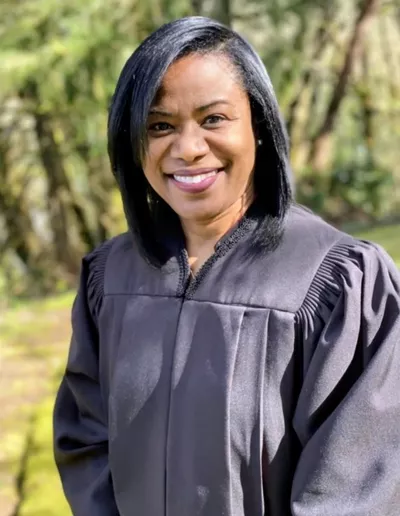
Judge Sharonda Amamilo is a Superior Court judge in Thurston County Superior Court in Olympia, Washington. Elected in 2020, she currently presides in family and juvenile court after previously serving in trial court, including adult felony and complex civil litigation matters. She has practiced law since 2003 and has experience in private practice, public defense, child welfare, juvenile defense, mental health defense, and foster youth representation.
Q: Can you tell us about your current role and legal background?
Judge Amamilo: I am a Superior Court judge in Thurston County Superior Court in Olympia, Washington. I was elected in 2020. I am currently assigned to family and juvenile court after having been assigned to trial court, which includes adult felonies and complex civil litigation.
I was sworn into the bar in November 2003. I served my first four years in private practice, including family law, juvenile law, child welfare law, and small contractor defense. From 2007 to 2019, I worked with the Thurston County Public Defender’s Office, primarily as a child welfare attorney. As a senior attorney, I became part of management and oversaw juvenile defense, involuntary commitment mental health defense, child support enforcement defense, and attorneys doing child welfare work.
In 2020, I contracted with the Office of Civil Legal Aid as a foster youth attorney, directly representing youth in South King County and Lewis County. That work allowed me to compare urban and rural systems, including resources available to families, how DCYF engaged families, and the different factors affecting families in crisis.
Q: What did that work teach you about systems and family needs?
Judge Amamilo: It opened up a lot of wisdom for me about the ecosystem around foster parents, kinship care, and whether families have what they need. I was able to do advocacy around systems change in Lewis County and King County that resulted in more protections around separating groups of siblings in Black and brown families, keeping them with families, and helping poorer families get resources quicker.
If you have a need, then that is part of my job. It is not just what I get to do in court. It is also going out into the community, advocating for supports, and helping rebuild people’s natural support networks.
Q: What systemic factors do you see affecting children and families?
Judge Amamilo: When you look at a child, you are looking at a system. You are looking at what is happening at school, what happens when they go to the doctor, what parents are getting in terms of parent education, and whether children are getting the same supports for the same behaviors.
I saw that some children received referrals, support, and parent groups around specialty diagnoses, while other children with the same outward behaviors received labels instead. They received responses from the disciplinary system instead.
I have seen it in school systems, healthcare systems, behavioral health systems, and specialty referrals that either get delayed or do not happen at all because behaviors are not attributed equally among children.
Q: How has cross-sector collaboration shaped your work?
Judge Amamilo: Alongside my work with clients, I was involved in every work group related to my work so I could understand where other stakeholders were coming from. I joined multidisciplinary work groups so I could learn from others and better collaborate to improve the impact on the population I represented.
I also joined statewide work groups, talked with regional administrators, and testified before the legislature about legislation I believed would better serve struggling families.
One example was developing a cross-system calendar for juveniles who were involved in dependency cases and also had juvenile justice cases. That allowed the court to have a fuller understanding of what was happening with that child.
Q: How do you bring that lens to the bench?
Judge Amamilo: I now preside over juvenile therapeutic court. I know how to identify trauma. I know how to communicate with parents who are struggling with their children or life circumstances, and I try to help them rebuild foundational structure.
The approach has become more strength-based. It is less about catching kids doing something wrong and more about helping them recover more quickly when they have a setback.
Q: Why is representation important in the judiciary?
Judge Amamilo: I believe a diverse judiciary is a fundamental right, on par with the right to a jury of your peers. Most cases people deal with every day are decided by a single judge. People should be able to see their community reflected in the justice system.
Diversity of thought comes from diversity of experience. When judicial bodies make decisions for all 39 counties, you need diversity of lived experience that represents the citizenry being served.
Q: How do you balance lived experience with the letter of the law?
Judge Amamilo: It is not my job to rewrite history. My job is to apply the law fairly to the case before me. At the same time, our constitutional system gives the courts, the Legislature, and the people through voter initiatives distinct roles in addressing historical wrongs when the law permits or requires it.
The way people experience the law matters. People have told me, “You’re the first judge who talked to me like I was a person.” That matters. Even when people do not receive the ruling they hoped for, they should feel respected and understand how the law was applied.
Q: How can courts strengthen public trust?
Judge Amamilo: Judicial officers have to get outside of the courthouse as often as they can to explain what courts are supposed to do and what people should expect.
People should know it is their court. Judges and justices are their representatives. They can be voted in and voted out. Communities should invite judges to speak, observe court when possible, and expect judges to be trained in trauma-informed practices.
My favorite word is “sonder,” the recognition that everybody’s life is as complex as mine. Everybody comes into court with some degree of baggage. I am aware of that.
Q: What is your vision for the court system?
Judge Amamilo: My number one vision is removing barriers so people can access courts and have their matters resolved on the merits. That includes rural courts, where legal services are spread thin, and people may not know how to access an attorney or the courts.
I am concerned when people miss the opportunity to have their cases heard because they could not figure out the process, did not have transportation, found the website too cumbersome, or lacked language resources.
Second, I want to address how different commissions, councils, and work groups often touch the same issues but operate in silos. With my systems experience, I want to help pull those efforts together so actionable findings can better serve people.
Q: How do you approach legal problem-solving?
Judge Amamilo: My rubric is FIRE: facts, issues, rules, and exceptions. What are the facts? What are the issues? What does the law say we have to do? What are the rules, whether statutory, policy, or system rules? And if the law does not provide a direct response, does it allow for an exception?
I am formulaic, but that formula includes the human impact. My goal is to get as close as possible to an outcome that solves the problem or brings relief in a way that allows people to move forward.
Q: Why is it important for people to understand how the law works?
Judge Amamilo: No one should leave my courtroom without understanding how the law was applied to them, their case, what they need to do next, and what they are able to do next. People need to be able to move forward.
Understanding how the law works is critical. It gives people a sense of empowerment and ownership in their community and country.