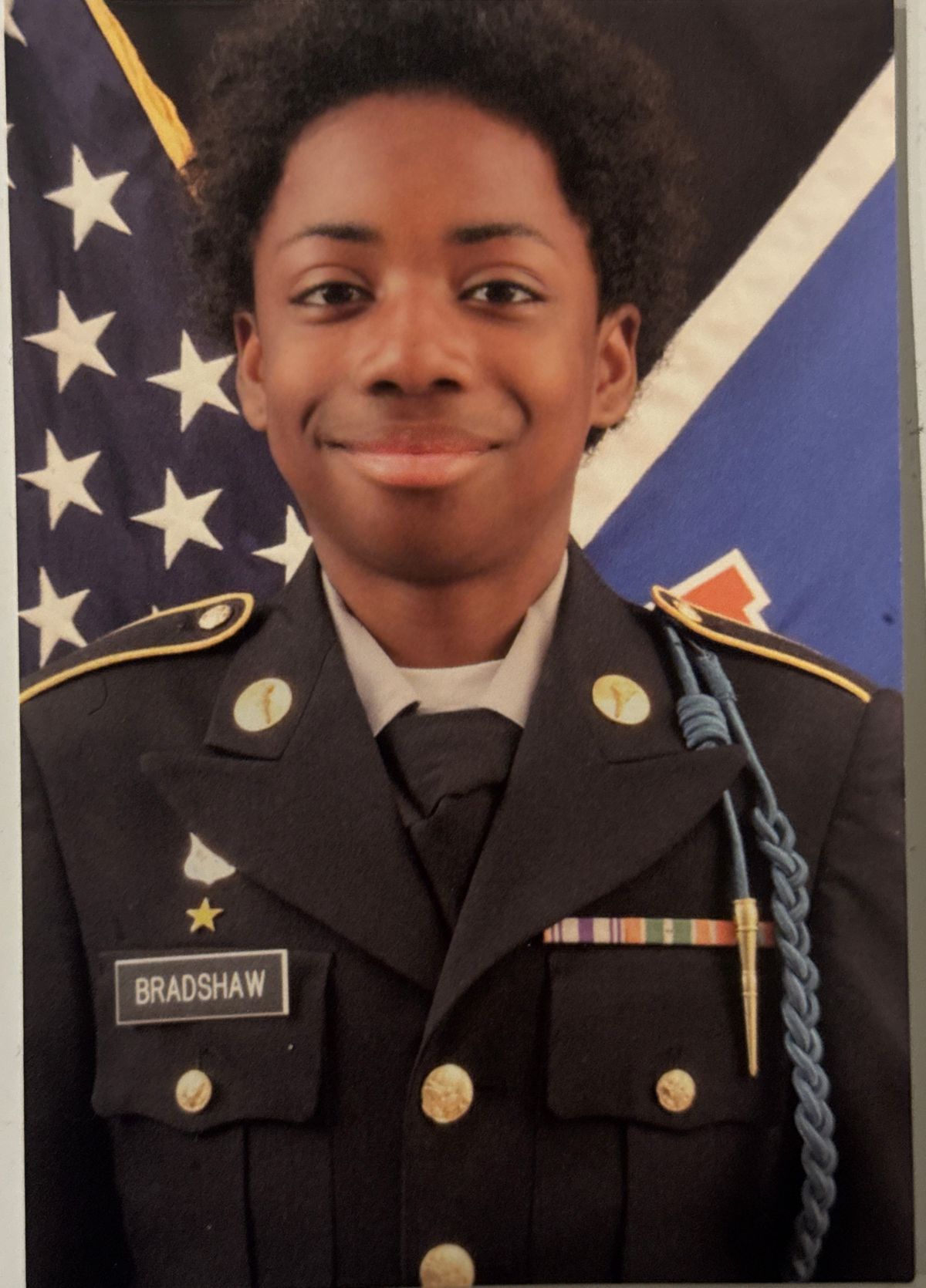
Katrinia Arnold didn’t set out to become a witness to someone else’s health journey. She simply invited a family she’d met through church into the outdoors, hoping to share a Northwest experience with newcomers from Miami. But on a winter hike to Franklin Falls, she watched 16-year-old Jeffrey “JJ” Bradshaw push forward in the cold, silent and determined, even as his discomfort was written all over his face.
At the time, Katrinia didn’t fully understand what JJ was carrying. Later, when she learned more about JJ’s sickle cell disease, his hospitalizations, and the physical pain he endures, that hike took on new meaning. She felt compelled to share his story, not out of pity, but out of respect.
Katrinia reached out to The Black Lens because she believed JJ’s story needed to be amplified and honored, and serve as a light for others.
A Q&A with Katrinia Arnold, Family Friend
Q: How did you first meet JJ and his family?
Katrinia: I met JJ and his family through church. JJ is part of our youth ministry, Teen Life.
Q: Can you describe the hike that first stood out to you?
Katrinia: When we did our first hike together, which was Franklin Falls, I didn’t know the extent of JJ’s illness or what was really going on with him. That day, it snowed on us. It was cold. And this young man trekked.
Q: What were you noticing as the hike continued?
Katrinia: I’ll be honest, at first I was thinking he’s young, he should be able to do it. But I saw the resiliency in him to finish. He completed it. He wasn’t pleased, and I’m sure he didn’t feel well, but he didn’t complain for the most part. He was humble about it. You could tell he was uncomfortable.
Q: Why did you feel compelled to reach out and help tell JJ’s story?
Katrinia: I felt convicted. I realized how easy it is to misjudge people when their pain isn’t visible. JJ’s resilience isn’t loud, but it’s real. People need to understand that strength doesn’t always look the way we expect it to. I realized how easy it is to misjudge what someone is going through when you can’t see their pain.
JJ’s World: A Conversation with Jeffrey ‘JJ’ Bradshaw
Q: Tell us a little about yourself. How old are you, what do you love, and where are you from?
JJ: I’m 16. I like to play basketball and do different types of sports. I do track. I like to play games with my friends, like 2K. I’m not from Washington. We moved here because of the military. I’m originally from Miami.
Q: How long have you lived in Washington?
JJ: Almost five years.
Q: How does it feel when you’re in a medical crisis and trying to explain your needs, but people don’t always listen?
JJ: Sometimes it feels frustrating because you’re trying to tell them what you need and what you feel, but they go based on their own assumptions instead of listening to what you’re saying. And you’re in pain at the same time, so it just makes it harder.
Q: You continue to show up even when things are hard. What does resilience mean to you? Where do you get your strength?
JJ: Whenever I need strength, I pray. But I also focus on having a good mindset. If I don’t have a good mindset, it’s just going to push me back further. I talk to God, ask Him to help me and heal me, and He’s always there. Everything comes from God and having a good mindset.
Q: What do you tell yourself when you don’t feel like pushing forward, but you do it anyway?
JJ: I think about how Jesus got on the cross. He didn’t want to, but it was something He had to do.
Q: What do you wish people understood about living with sickle cell, beyond the medical definition?
JJ: I have the ability to live a life like everybody else does. It’s a little different and has more complications, but it doesn’t mean my life is bad or that I’m unfavored by God. I can do the same things everybody else can do, just with some restrictions.
Q: When you’re experiencing a flare or a pain crisis, what is that like for you physically and emotionally?
JJ: Physically, my body gets really weak. Mentally, I try to keep the same mindset and keep myself up, but sometimes it gets hard because I’m in a lot of pain.
There was a time I had to crawl down the stairs to get to an appointment because I couldn’t walk. I laid on the floor to get dressed and crawled downstairs. When I finally got outside, I was in so much pain I fell asleep in the truck. They had to put me in a wheelchair at the hospital because I didn’t want to hurt myself more.
Q: What does the pain actually feel like?
JJ: A lot of the time it’s in my legs or my arms. It’s like an aching pain that goes away and comes back, over and over.
Q: Your mindset plays a big role in how you move through challenges. How do you stay grounded when your body isn’t cooperating?
JJ: I tell myself I can do it. I know I have the strength to do it.
Last year, I had avascular necrosis in my legs. I had to quit track, and I was in the hospital and in a wheelchair. But the next year, as a freshman, I made varsity track. I stayed connected with my coaches, and they listened to me. Having people who understand helps a lot.
Q: How do you know when it’s time to rest and slow down?
JJ: Sometimes I don’t really know when to stop. That’s when my mom steps in and tells me, “Alright, son.” I’m glad I have her, because if I didn’t, I’d probably push myself too far.
Q: What are your goals for the future? What keeps you motivated?
JJ: First, college. Then I want to study to be a doctor. I want to play basketball in college, go to the NBA, and be a doctor. That’s the plan for now.
JJ’s strength does not exist in isolation. Behind his discipline, faith and resolve is a mother who has learned to navigate systems that too often fail Black families and children with complex needs.
A Mother’s Advocacy: A Q&A with Eugenia ‘Gina’ Bolton
Q: Tell us about your family and what it has been like navigating military life while caring for a child with complex medical needs.
Eugenia: My husband is active duty. Prior to meeting my husband, who is JJ’s stepfather, I pretty much had JJ’s health care down pat. When we married, this was our first time PCS’ing as a family to Washington.
I thought the health system was going to be better because it’s military. You assume they would know more when it comes to kids with disabilities. But I quickly learned that’s not always the case.
Sometimes I wish we were back home so he could get the care that he needs, because it has been challenging. I find myself advocating a lot for him.
Q: How well does the medical system in Washington understand sickle cell disease?
Eugenia: They don’t. Not at all. It’s like it’s foreign to them.
When you have a sickle cell patient experiencing a pain crisis, it’s routine where I’m from in Miami to state that he’s a sickler, make sure he doesn’t have a fever, and if he does, take him straight to the back. You don’t wait three or four hours in the waiting room.
Here, I constantly have to say, “My child is in pain. What’s the next protocol?” And it’s like they’re ignorant to what’s really going on.
Q: What kinds of assumptions have you encountered while seeking care for JJ?
Eugenia: I’ve had situations where people assumed my child was seeking pain medication. And I’m like, if you look at my child’s case, I don’t even allow certain medications.
Prayer is big for us, but I also have wisdom. God gave doctors for a purpose. But I also need them to understand that I’ve been his mom for sixteen years. I would think that would be taken into consideration when I say something is wrong with my child.
Q: What is the one thing you would tell the medical system, as a parent who has lived through these crises?
Eugenia: Doctors and nurses take an oath, and that oath should not see color. It should not make assumptions.
Parents are with these kids 24/7. You might see them for 30 minutes or an hour. If we’re asking for certain tests or saying something isn’t right, listen. Consider what we’re saying. We know our children.
Q: Can you share a moment when not being listened to had serious consequences?
Eugenia: JJ started having headaches, and I noticed his voice changing. The tone of his voice wasn’t the same. I couldn’t explain it medically, but I knew something was wrong.
They didn’t listen. Later, when they finally did blood work, his hemoglobin was at a four. He could have had a stroke. Anything could have happened.
Q: How have you learned to advocate within the military medical system?
Eugenia: At first, it was just me. No patient advocate. No caseworker.
So I started calling leadership. I didn’t know their rank. I didn’t care. This is what’s happening, and this is what I need for my child.
Eventually, I contacted the chief of the hospital. Titles don’t mean anything to me. My child’s life does. And once I did that, things started to change.
Q: What advice would you give to other military parents navigating complex medical care for their children?
Eugenia: Don’t do this alone. Find community. Ask questions. Somebody always knows something that can help you.
I used to think I had to handle everything by myself. But community matters. And don’t let one bad experience stop you from advocating. You can ask for another doctor. Another nurse.
Q: Faith is clearly central to your journey. How has it sustained you?
Eugenia: I’ve seen God’s hand on my son’s life from the beginning. I’ve seen miracles. I’ve seen him survive things doctors said he wouldn’t.
I always tell JJ that God is going to use his story to bless other people. Never let anyone tell you what you can’t do. We can do all things through Christ Jesus that strengthens us.
Q: When you look at JJ today, what do you see?
Eugenia: I see resilience. I see purpose. I see a young man who has been through more than most adults and still shows up. And I’ll continue to fight for him, every step of the way.