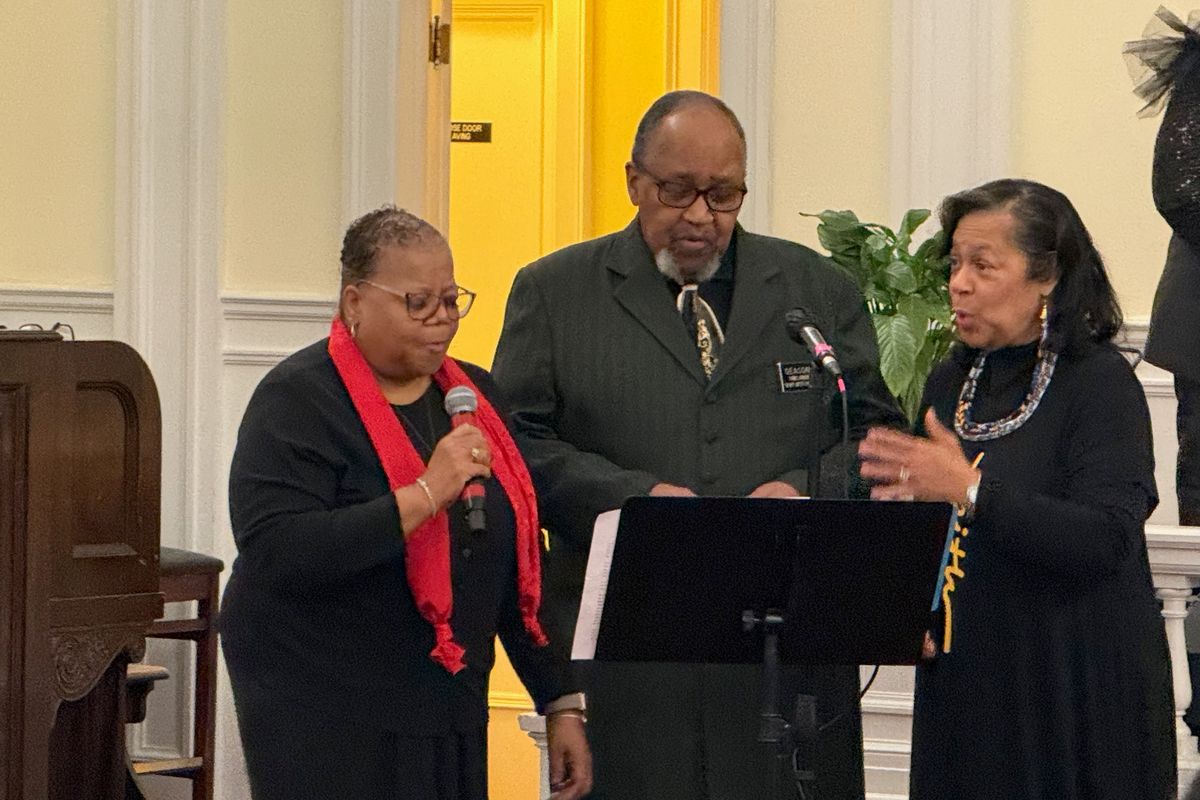
As we march through 2026, Americans are once again faced with a defining choice: whether to erase or acknowledge the late Rev. Dr. Martin Luther King Jr.’s legacy and his enduring contributions to America’s civic and moral landscape. For those of us who have been on the battlefield for a lifetime, our collective work paved the road for the 1964 Civil Rights Act and the 1965 Voting Rights Act. At the time, justice took tangible form through federal legislation that expanded access to the ballot, fair housing, and equal access to education–cornerstones that served, if you will, as a moral compass for America’s leadership. Today, these historic constitutional legislative acts are once again on the chopping block.
The history of voting in the United States is both rich and complex. To begin, we can consider The 1619 Project by Nikole Hannah-Jones and The New York Times Magazine, which offers a reexamination of American history by marking 1619–the arrival of the first enslaved Africans in Virginia–as the nation’s actual founding moment. This perspective places the legacy of slavery and the contributions of Black individuals at the forefront of the national narrative, offering critical insight into contemporary America. I strongly encourage students to engage deeply with American history; without this understanding, it becomes exceedingly difficult to connect the past to the future.
It is also essential to reflect on the European settlers who first inhabited the land before consolidating control over what is now the United States. During the colonial period, voting rights were limited to white men. As territories expanded, these regulations evolved to allow only white landowners to participate in the electoral process. This exclusion severely restricted the voting rights of free Black individuals–many of whom were homeowners and landowners–and systematically disenfranchised them. Permitting free Black citizens to register would have increased voter participation among Black Southerners and empowered them at the ballot box, potentially leading to significant changes in the political landscape. Such participation would have directly challenged a state political system that controlled nearly every aspect of life for its citizens, particularly Black communities. That system was rooted in white supremacy, ethnocentrism, and a rigidly stratified class structure marked by disparities in wealth, prestige, and power.
Unlike earlier civil rights movements, today’s social justice organizations are often dispersed across the nation, addressing a wide range of issues without a unified action plan. Yet they share a common aspiration: a just society that includes access to health care, equality, living wages, affordable housing, and equitable access to financial institutions that provide home loans. We recognize that banks continue to vary significantly in their willingness to lend to Black and Brown individuals. These movements seek an America that works for everyone.
The pressing question now becomes: How do we navigate this moment in our history?
Leadership is not solely the product of obtaining a college degree; it emerges from an intrinsic calling–as though one were destined to step into such a role. Many may feel this call, but only a select few are chosen to answer it fully. As George Clinton and Parliament-Funkadelic so aptly put it in “Gamin’ On Ya,” everybody wants a change, but ain’t got sense enough to come in out of the rain.
Authentic leadership is defined by character rather than wealth. We are shaped into adulthood through a process anthropologists call enculturation–the social mechanism through which culture is learned and transmitted across generations. Dominant culture profoundly shapes our moral compass and the political, social, and economic frameworks that govern society. When explaining enculturation to my students, I often describe it this way: we enter the world as a blank slate, with no inherent understanding of our surroundings. We learn what to eat, how to dress, which rituals to observe, what to believe, and how to interpret the world from our environment. These cultural norms are passed from one generation to the next.
To be clear, individuals are not born wife beaters, nor are we born racists. These are learned ideologies and behaviors–products of enculturation–through which individuals internalize the beliefs and practices modeled by caregivers and society. What we become as adults is directly linked to this process.
In terms of leadership, our nation currently finds itself engulfed in chaos–marked by conflict, confusion, gaslighting, fear, and harassment. This turmoil is intensified by overt racism perpetuated by those in power, layered with high unemployment, rising food costs, diminished freedoms, and deliberate threats designed to undermine “We the People’s” sense of identity and belonging.
As thoughtful Americans, we entered 2025 beneath a heavy and dark cloud looming over our collective landscape. As time has passed, divisions have deepened over cultural battles, institutions have deteriorated, and a pervasive haze has settled in–one that feels nearly impenetrable. Many feel powerless to influence unfolding events; the People’s House has strayed far from its authentic purpose, leaving citizens unsettled and often without recourse.
On Aug. 11, 1956, Dr. Martin Luther King Jr. delivered his speech “The Birth of a New Age” at the Statler Hotel in Niagara Square, Buffalo, New York. In that address, he observed:
“Those of us who lived in the 20th century are privileged to experience one of the most significant periods in human history. This is an exciting time, brimming with hope, as a new world order takes shape. We find ourselves standing at the crossroads of two worlds–the declining old and the emerging new.
Some may argue that we inhabit the darkest chapter of human history, pointing to the deep-seated unrest in Asia, the uprisings in Africa, the nationalistic longings of Egypt, and the racial tensions in America as evidence of a tragic midnight enveloping our civilization. They would claim that rather than progressing, we are regressing–moving backward instead of forward.
However, the current tensions should not be seen as signs of regression or hopelessness. Instead, they are the necessary pain that accompanies the birth of anything new. Historically and biologically, growth and birth are inseparably linked to the pains of transition. Wherever the new emerges and the old begins to fade, this truth holds. Thus, the tensions we witness today reflect the reality that a new world is coming into being, even as an old world passes away.”
Here we are in 21st century America, witnessing the death of the old and the birth of the new. As singer-songwriter, musician and poet Curtis Mayfield reminded us decades later, it’s a new world order.
Terry Buffington is a Cultural Anthropologist, BA, M.Ed., MA, and president of the Terry Buffington Foundation, Inc. More information can be found online at terrybuffingtonfoundation.org.