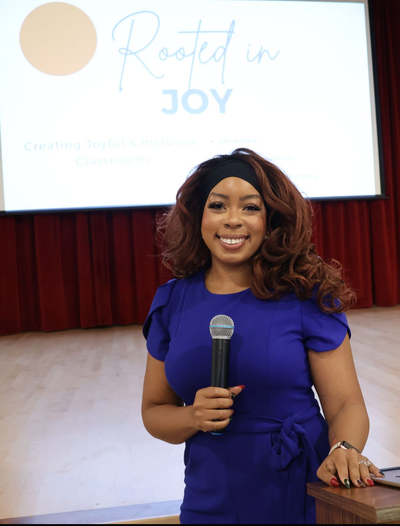
From Spokane to Los Angeles, Professor Deonna Smith’s journey is a testament to the power of education, perseverance and purpose. Raised in Spokane, she was shaped by community, family, and early lessons that would later inform her work in social justice education.
Her academic journey was not without obstacles. Like many students of color, she navigated systems that were not designed with her in mind. Yet through mentorship, self-belief, and faith in her calling, she pressed forward–earning credentials while cultivating compassion.
The transition to Los Angeles marked a defining chapter. The pace was faster, the stakes higher, and the need for resilience undeniable. In that environment, Deonna refined her voice and clarified her purpose.
Today, as a professor at Loyola Marymount University, she stands at the intersection of education and justice. Her work centers communities of color, ensuring that students are not only informed, but empowered.
For Deonna, social justice is not theoretical–it is lived. It shows up in classrooms, conversations, and community engagement. She believes education is one of the most powerful tools for transformation.
To the youth reading this, her message is clear: your beginnings do not limit your impact. Where you start does not define where you can go.
Interviewing my daughter was one of the most humbling experiences of my life. As a father, I’ve watched her grow. As a journalist, I witnessed her purpose.
This conversation reminded me that our children’s stories are not extensions of us–they are testimonies of their own calling. I am proud not only of what she has accomplished, but of who she has become. To parents and elders reading this: nurture the seeds, but trust God with the harvest.
Raised in Spokane in the 1990s, Professor Deonna Smith came of age in a city that felt small, quiet, and far less diverse than it is today. Downtown Spokane had not yet experienced its revitalization, and opportunities for cultural connection were limited. Yet in that stillness, Deonna found space to imagine–to dream beyond the boundaries of what she could see.
“Spokane felt almost Midwestern,” she recalls. “Very suburban. Very quiet. There wasn’t much to do–but in some ways, that allowed me to focus on dreaming about what I wanted to do in the future.”
Growing up, she spent time downtown at River Park Square, volunteered extensively and became involved with youth leadership opportunities like the city’s youth commission. While Spokane’s Black population was small, it was deeply invested in the success of its young people.
“The lack of diversity was a challenge,” she says, “but the Black community that was there really showed up. People wanted to see Black youth thrive, and that support helped me see a pathway forward.”
Dreaming beyond a small world
Like many young people raised in smaller cities, Deonna did not initially grasp how expansive the world could be. Many of her peers pursued local college paths and returned home, content with familiarity. For her, that felt limiting.
“I wanted a more colorful, vibrant, full life,” she explains. “But when you’re in a small town, it’s hard to know how to make that happen.”
As a first-generation college student and one of few Black students in academic spaces, the path forward was often unclear. Still, mentors and community members helped her navigate unfamiliar terrain. Educators, community leaders, and family members–parents, grandparents, and extended support systems–collectively rooted for her success.
Among the most influential experiences was her Montessori education from first through sixth grade. Deonna credits this foundation as pivotal.
“Montessori taught me how to be a critical thinker,” she says. “I didn’t have a cookie-cutter school experience. We traveled, learned about different cultures, and questioned the world around us. That foundation transformed everything.”
She names her Montessori teacher as instrumental in teaching her how to seek knowledge, ask questions, and understand the world beyond textbooks–skills that continue to shape her work today.
Education as purpose, not just achievement
Over time, Deonna began to see education not as a guaranteed equalizer, but as a system marked by inequity.
“I had some incredible teachers,” she reflects, “but I also saw how education isn’t equitable. I was always the student ‘beating the odds.’ At some point, I started asking–what if we changed the odds instead?”
Initially drawn to international relations and global education, Deonna envisioned working abroad. Inspired by global models and figures like Oprah Winfrey, she imagined educational justice on an international scale. She even taught in Chile for a year, an experience that affirmed her love for teaching.
“I realized I was good at it, and more importantly, I was fulfilled by it,” she says. “Education became the place where my passion for social justice and my lived experience came together.”
That realization set her firmly on a path toward education as a tool for transformation.
At the intersection of education and justice
Since graduating college, Deonna has worked across the educational spectrum–elementary, middle, and high school classrooms, leadership roles, coaching, and professional development. Her years of experience culminated in a book contract and the publication of Rooted in Joy, a work centered on equity, belonging, and joy in schools.
“The research is there,” she explains. “We know how students–especially Black and Brown students–learn best. But that information doesn’t always reach teachers. The book is my attempt to bridge that gap.”
The book’s success opened doors at the university level, eventually leading her to Loyola Marymount University, a Jesuit institution in Los Angeles. There, she coaches educators and teaches African American Studies–often to students encountering these conversations for the first time.
“It’s a politically charged moment,” she acknowledges. “Race, history, and truth are being challenged and sanitized. Many of my students aren’t Black. Some are in the class only because it’s required. But that’s also what makes it powerful–we get access to conversations that might not happen otherwise.”
She sees the classroom as a rare opportunity to guide students toward deeper critical thinking, awareness, and responsibility.
Why education is liberation
For Deonna, education has always been inseparable from liberation.
“Throughout history, the oppressor always targets education first,” she says. “Control the mind, and you control the people.”
In an era of misinformation, artificial intelligence, digital overload, and shrinking attention spans, she believes critical thinking is under greater threat than ever. The erosion of educational institutions and the devaluing of intellectual curiosity, she warns, are not accidental.
“Education has to be the origin point for liberation–for all people,” she says. “If we reclaim our minds, the rest follows.”
She emphasizes that this work begins early–with young children–and continues across a lifetime. Curiosity, discernment, and ownership of one’s mind are essential tools for freedom.
Growth, joy and staying grounded
As a Black woman and educator, Deonna continues to learn–especially the importance of internal work.
“We can internalize anti-Blackness without realizing it,” she reflects. “If we don’t interrogate ourselves, we risk reproducing the very systems we’re trying to dismantle.”
She approaches education as a renewable resource rather than a draining one. For her, joy, human connection, and learning alongside others are sustaining forces.
To stay grounded, she gardens, nurtures her family and community, and intentionally finds joy in the work.
“Activism doesn’t have to be clenched fists all the time,” she says. “It can be joyful. That joy is what keeps me going.”
A Message to Young People
To Black Lens readers–and especially to young people–Deonna offers a message of courage and pride.
“Be brave. Try things. Don’t be afraid to make mistakes,” she says. “Being Black is a gift. It’s a legacy of greatness.”
She encourages young people, particularly those growing up in smaller cities like Spokane, to believe in their possibilities and trust their instincts.
“If I hadn’t taken risks, I wouldn’t be where I am today,” she reflects. “You don’t have to have it all figured out. Just move.”
Where to find her work
Deonna Smith’s book, “Rooted in Joy,” is available through Amazon, Barnes & Noble, and Black-owned bookstores including Reparations Club and Mahogany Books. She encourages readers to purchase copies for themselves and for educators–especially within Spokane Public Schools.
“It would be a dream,” she says, “to see this work return to the community that raised me.”