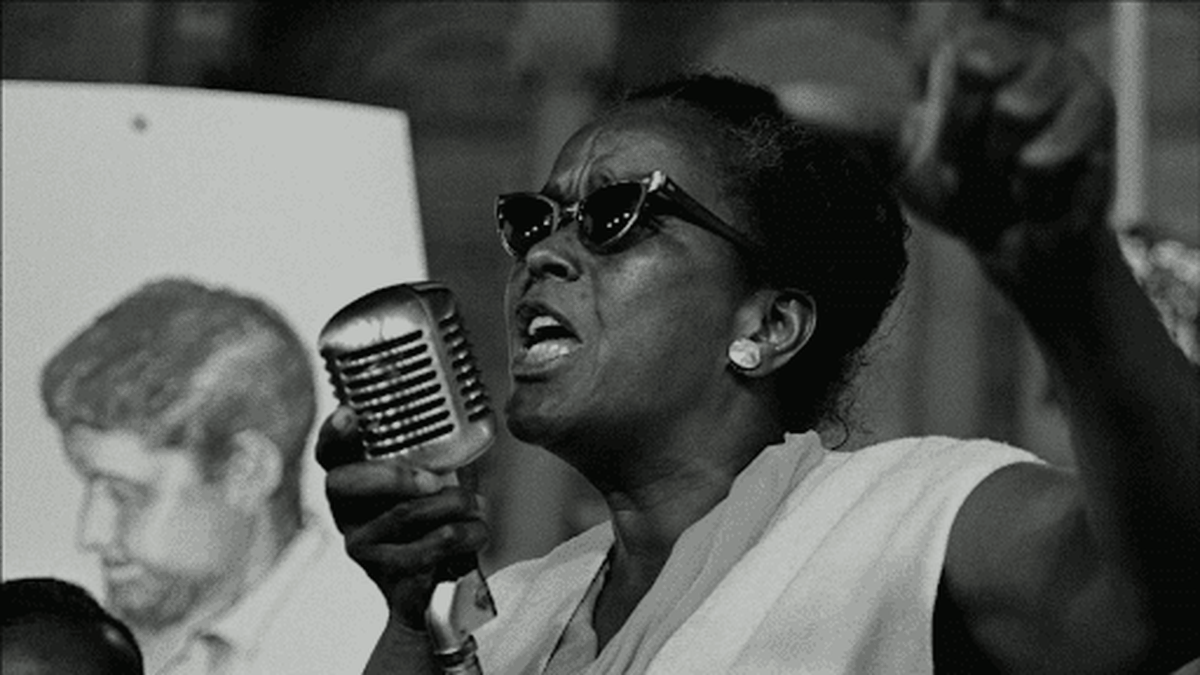
“A powerful woman knows when to speak and when her silence will say more.” In the standard telling of the American Civil Rights Movement, history advances through singular voices: thunderous speeches, iconic marches, and men standing at podiums framed by flags and cameras. Ella Josphine Baker did not stand at podiums. She sat in meetings. She asked questions. She listened. And in doing so, she helped build one of the most powerful democratic movements in American history. She was known as the “Mother of the Civil Rights Movement.”
Who was Ella Josphine Baker? Born December 13, 1903, in Norfolk, Virginia, and raised in Littleton, North Carolina, Baker grew up hearing stories that taught resistance as a way of life. Her grandmother, once enslaved, was remembered for refusing physical punishment, enduring beatings rather than submission.
For decades, Baker worked quietly behind the scenes, shaping strategy, challenging hierarchy, and insisting that ordinary people–young people, working people, rural people–were capable of leading their own liberation. “Strong people don’t need strong leaders,” she often said, a phrase that would become both her credo and her critique of the movement she helped sustain.
She attended Shaw University, a historically Black college in Raleigh, Baker quickly distinguished herself as a dissenter. She challenged school rules, questioned authority, and graduated as class valedictorian in 1927. But rather than pursue personal acclaim, she moved to New York during the Harlem Renaissance, where her political education deepened. There, she became involved in labor organizing, cooperative economics, and radical study groups that stressed collective action over individual advancement.
That philosophy would define her life’s work. In the 30’s and 40’s she became one of the National Association for the Advancement of Colored People’s most effective and powerful organizers. She traveled relentlessly across the South, as a field secretary and later director of branches. Navigating hostile territory, often going alone, her role was to recruit members and strengthen local chapters. Baker had an amazing strategy, she focused on “people,” churchgoers, teachers, domestic workers, helping them to see themselves as people of importance.
She believed organizations were only as strong as their grassroots. National offices, she argued, could not substitute for local leadership. Her approach was practical and demanding: hold meetings, develop skills, share responsibility. It was slow work. It was also transformative.
Baker’s insistence on decentralized leadership often put her at odds with the movement’s dominant structures. In 1957, she helped launch the Southern Christian Leadership Conference (SCLC), formed in the wake of the Montgomery Bus Boycott. But she soon grew frustrated with what she saw as an overreliance on charismatic male ministers and press-driven leadership. The model, she believed, discouraged participation and reinforced hierarchy–even within a movement dedicated to freedom.
Her criticism was sharp but principled. She admired Martin Luther King Jr.’s moral leadership but resisted the idea that movements should revolve around singular figures. “The movement made Martin, and not Martin the movement,” she once remarked, underscoring her belief that collective struggle–not individual brilliance–creates lasting change.
The turning point of Baker’s public influence came in 1960, when Black college students across the South launched sit-ins at segregated lunch counters. While established leaders debated how to control or absorb the protests, Baker recognized their significance immediately. She organized a conference at Shaw University that brought student activists together, not to discipline them, but to help them chart their own path.
The result was the Student Nonviolent Coordinating Committee (SNCC), an organization that would become the most daring and grassroots-oriented arm of the Civil Rights Movement. Baker deliberately encouraged SNCC to remain independent of older organizations, believing that young people needed the freedom to experiment, fail, and lead.
SNCC organizers went on to conduct voter registration drives in some of the most dangerous parts of the Deep South, organize Freedom Summer in Mississippi, and challenge both segregation and political exclusion at their roots. Many of its leaders–John Lewis, Diane Nash, Bob Moses–carried Baker’s lessons with them: listen first, trust local people, share power.
As a Black woman operating in male-dominated organizations, Baker often confronted sexism without naming it directly. She preferred to demonstrate an alternative. She mentored women, encouraged youth leadership, and modeled authority rooted in respect rather than control. Her influence can be traced through the work of figures such as Septima Clark and Fannie Lou Hamer, who embodied her belief that those most affected by injustice must lead the fight against it.
By the late 1960s, as the movement fractured under the weight of violence, repression, and internal conflict, Baker remained committed to grassroots organizing, working on political education and international solidarity. She never sought to rehabilitate her public image or claim credit for past victories. That restraint, while principled, contributed to her relative obscurity in popular histories.
Ella Baker died in 1986 at the age of 83. For years, she was remembered primarily by organizers and scholars, her name circulating quietly in footnotes and movement spaces. Only recently has her legacy begun to receive broader recognition, as contemporary movements increasingly reject hierarchical leadership in favor of collective models.
Today, Baker’s ideas resonate powerfully. From community-led voter mobilization to mutual aid networks and youth-driven activism, her influence is visible wherever people organize themselves rather than wait to be led. At a time when political life often feels dominated by spectacle and personality, her example offers a different lesson: democracy is not performed; it is practiced.
Ella Baker never wanted to be the face of a movement. She wanted people to recognize their own power. In that sense, her success is everywhere, shining brightly–and still unfinished She said, “Give people light and they will find their way.”