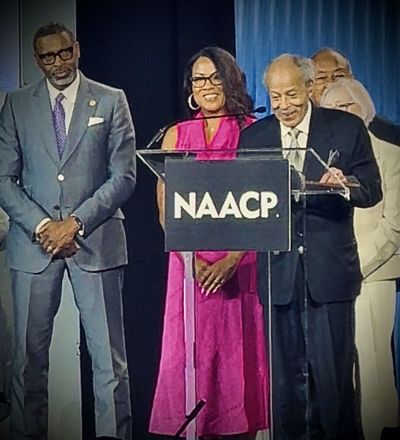
CHICAGO — One of the most inspiring moments of the 117th NAACP National Convention came as retired U.S. Air Force Capt. Ed Dwight reflected on a journey that began more than six decades ago when President John F. Kennedy selected him to become the nation’s first Black astronaut candidate.
Dwight received the NAACP Armed Services and Veterans Affairs Award in recognition of his groundbreaking military service, artistic legacy, and lifelong commitment to preserving Black history through public art. During his remarks, the 92-year-old credited the NAACP with standing beside him during one of the most difficult periods of his life, when racial discrimination threatened to derail his dream of becoming an astronaut.
Recalling his selection to the Air Force’s aerospace training program in the early 1960s, Dwight acknowledged both the opportunity and the barriers he faced.
“Sixty-five years ago, when the president appointed me to the space program… my odds of succeeding at that were slim, mainly because of the racism involved.”
Dwight described how members of the Los Angeles NAACP quietly stepped in to mentor and encourage him after he entered the program. He said they recognized that beyond the rigorous demands of flight training, he would also need guidance navigating the public attention that came with being the nation’s first Black astronaut candidate.
“They were there counseling me and giving me good advice,” Dwight said, explaining that the organization’s support strengthened his confidence during a time when many expected him to fail.
After President Kennedy’s assassination, Dwight said the NAACP continued to stand beside him as his path into the space program changed. Although he ultimately left the military and built an internationally recognized career as a sculptor, he said the organization remained a partner, later helping raise support for many of his public memorials honoring Black history and achievement.
Today, Dwight has created approximately 133 monuments and memorials celebrating Black progress across the United States. In 2024, more than 60 years after he was first selected for the space program, he finally fulfilled his dream of traveling to space.
Accepting the award, Dwight reflected on the significance of receiving the honor from an organization that had supported him throughout his life’s journey.
“I really am overwhelmed at this whole process of being honored like this,” he said. “At this age, I kind of need it.”
The audience responded with a standing ovation, celebrating not only Dwight’s historic achievements, but also his perseverance in overcoming barriers that once kept him from reaching the stars.