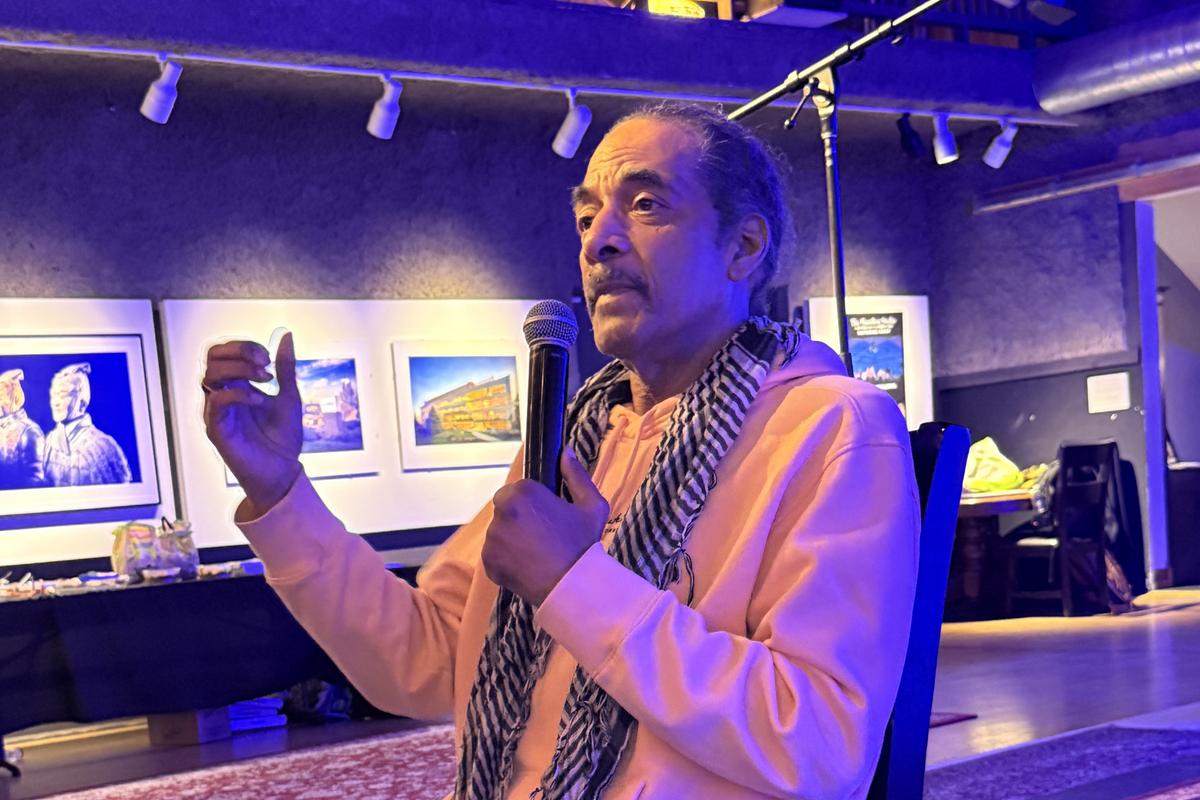
In a time marked by hyper-individualism, grifting, and spin-off movements, Aaron Dixon offers a grounded reflection on what it once meant to move as a collective and what it will take to return. As a co-founder of the Seattle chapter of the Black Panther Party in 1968, Dixon’s life bridges living history and present-day urgency.
In this conversation, he traces the roots of his political awakening, the erosion of community-based value systems, and the disciplined strategies that once transformed neighborhoods into sites of grassroots action. He also reflects on how power actually works, not just in theory, but in practice.
Q: As a teenager, you marched with Martin Luther King Jr. and witnessed early integration efforts. How did those experiences shape your decision to co-found the Seattle Black Panther Party?
Aaron Dixon: “I think for everybody, it was a process of growing up in that time period. Who our parents were, where they came from, their experiences. We grew up under segregation, and our parents and grandparents lived under segregation.
The oral tradition was very much alive. We heard stories from our parents, grandparents, aunts, uncles, not just about family, but about the things they went through.
We grew up watching the Civil Rights Movement play out on television every day. We watched the news with our parents. All of that played a role for our whole generation.
We also witnessed assassinations. John F. Kennedy, Medgar Evers, the bombing in Birmingham. I remember my father crying when Kennedy died. That was the first time I saw him cry. I realize now it was traumatizing for us as young people.”
Political consciousness is often not born in a single moment, but in a lattice shaped by family, media, trauma, and shared witnessing. Dixon’s generation did not arrive at activism individually. It was formed through collective consciousness, emotional nearness, and historical urgency.
Q: You spoke about growing up surrounded by elders. How critical was that intergenerational connection?
Aaron Dixon: “It’s critical. It was part of the cultural value system we lived under. Respect your elders. That was driven into us.
But also, young people were valued and looked after by everybody, not just family, but the whole community. The family was important. People stayed together for the sake of the family.
Under segregation, we had everything in our community. Doctors, lawyers, businesses. It was a community effort in raising children and raising the community.
We don’t have that anymore. That cultural value system has been eroded.”
Where today’s culture often emphasizes independence, Dixon describes a time when identity was anchored in relationship. The loss he names is not just emotional. It is structural. It is the shift from “we” to “I.”
Q: Do you see individualism as part of that erosion?
Aaron Dixon: “Yeah. We don’t have those ways of socializing anymore. People used to sit on the porch, talk to neighbors. That’s how we built relationships.
Now, we have to be intentional. We have to learn how to be together again, how to talk, how to learn from each other.
Technology is one of the things keeping us from getting back to that. But it doesn’t mean it can’t be done.”
Dixon does not romanticize the past, knowing full well that it came with its own injustices. But he is clear that collective life was practiced, not assumed. If it is to return, it must now be rebuilt deliberately.
Q: There’s a lot of emotion in movements today, but less structure. What are your key principles for effective organizing?
Aaron Dixon: “Groups should learn how to study together. Create a book list. Read, study, and discuss on a regular basis.
You have to understand the importance of principles. Basic principles. Be respectful. Return what you borrow. Simple things.
We used to say practice is a criteria for truth. People have ideas, but they don’t put them into practice.
You need a plan. A strategy. A vision. A goal. Then you map out how you’re going to get there. And you hold people accountable.
You don’t just talk about it. You put it into practice.”
For Dixon, organizing is not reactive. It is disciplined. Study, values, structure, and accountability are the backbone of collective action. In their absence, decentralized efforts often collide, compete, or lose direction instead of building unified resistance and lasting infrastructure.
Q: Many movements today struggle with internal conflict. How did you navigate disagreement within the Panthers?
Aaron Dixon: “One of the principles we learned was constructive criticism. If you see something wrong, you address it, not in an attack, but in a constructive way.
And the other person accepts that criticism.
A lot of times now, people don’t bring things out. It festers. Then people split. But you never talked about it.”
Dixon identifies fragmentation not as inevitable, but as the result of avoided accountability. A willingness to work through tension, rather than flee from it, is central to collective power.
Q: What is different about how your generation and today’s youth experience trauma?
Aaron Dixon: “In our segregated communities, we had love and support. When I came back from Oakland, I was dealing with trauma. But I came back to my neighborhood, and people knew me. They spoke to me. That helped me heal.
We had love in our community. It was easier to heal.
Now there’s so much chaos. It’s harder to heal. So we have to be intentional about creating spaces of love and support.”
The distinction Dixon draws is not in the existence of trauma, but in the existence of community. Healing, in his framing, is collective, not individual.
Q: There’s an ongoing debate between abolition and reform. Where do you stand?
Aaron Dixon: “It’s both. You can’t deal in absolutes.
You can’t just tear everything down without having something in place. You have to build programs.
If you want to abolish something like prisons, you need something for people when they come out. Something that helps them reintegrate.
We can’t get stuck on terms. You have to do the work.”
Dixon reframes the debate from ideology to strategy. What matters most is not the label, but the outcome and whether people’s material conditions are actually changed.
Q: The Panthers are often remembered for their image, but less for their programs. What did successful organizing look like in practice?
Aaron Dixon: “We evolved. We started with uniforms and guns, but we shifted.
We started survival programs. Free breakfast programs. Free medical clinics. Legal aid.
We fed thousands of kids. We helped force the government to create national programs.
That’s how you transform something. You build what’s needed.”
This is where Dixon’s critique of individualism sharpens. The Panthers were not performing resistance. They were building systems. People’s power was measured in impact, not visibility.
Q: What is one of your most powerful memories from that time?
Aaron Dixon: “We had a vision to take over the city of Oakland. And we moved toward that.
We helped put Black judges in place. We influenced elections. We had one of the best community-based schools in the country.
We were running the city. That was about strategy and practice.”
His answer underscores a central truth. Real power is not symbolic. It is structural.
Q: You’ve talked about strategy a lot. What does power look like to you now?
Aaron Dixon: “You have to be strategic. You have to have a long-term strategy.
Your short-term actions may not always fit your ideology, but they’re part of getting where you want to go.”
Dixon also offered a deeper reflection on power, one rooted not in visibility, but in strategy. He pointed to his run for U.S. Senate as a defining example.
“We knew that I could not beat Maria Cantwell,” Dixon said. “But I could persuade her to do what we wanted her to do, which was stop asking for more support for the war in Iraq.”
Rather than centering the campaign on victory alone, Dixon approached it as a strategic opportunity to influence policy and shift the conversation.
“That’s what our campaign did,” he said. He shared that Cantwell eventually changed her position.
The campaign also revealed something broader about reach and influence.
“The largest percentage of votes that I got was in the eastern part of the state, right here, conservative white people,” he said. “As a matter of fact, it set a record.”
For Dixon, these outcomes underscore a critical lesson about power and how it operates. Power is not only held by those in office. It can also be applied, redirected, and leveraged with intention.
In a culture that often celebrates visibility over substance, Dixon’s reflections offer a recalibration. The shift from collective power to individual expression has not just changed how movements look, but how effective they are. The work takes all of us. When collective practice erodes, we trade progress for futility.
And like anything unpracticed, it can be rebuilt.
Aaron Dixon shared at the PJALS Youth Kick-Off event at Hamilton Studios on March 20 the essence of the Black Power and Civil Rights Movements. We cannot live in fear; we have to live in our own power.
All Power to the People.