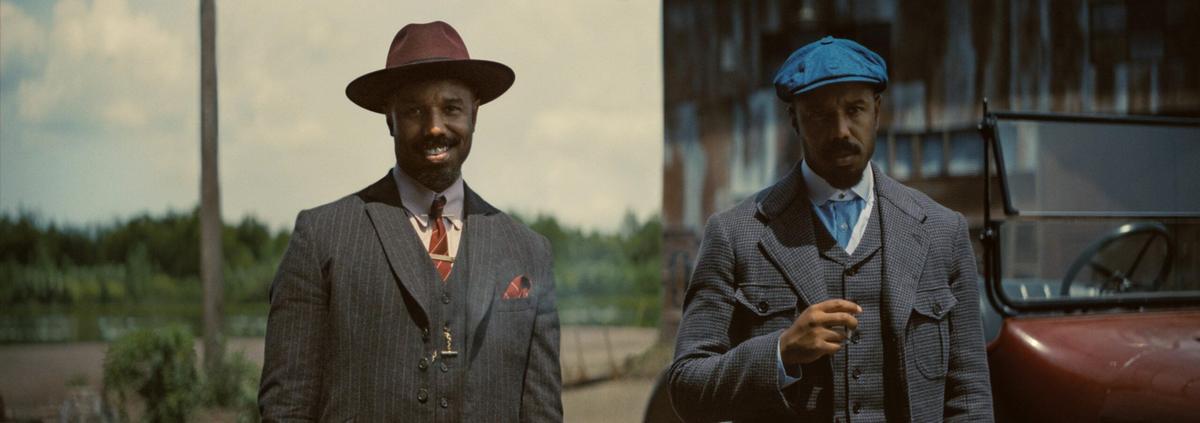
Ryan Coogler’s “Sinners” (2025) made history at the 86th Academy Awards with 16 nominations and four wins in the categories of Best Actor for Michael B. Jordan, Best Original Screenplay, Best Cinematography and Best Original Score. The film is groundbreaking in the way it fuses horror with historical reflection, crafting a story that uses metaphor to hold space for deeper conversations about American history and the power of cultural expression. Throughout the film, messages, both subtle and direct, invite viewers to reflect on the long shadow of the past. Central to the story’s formula is the Blues, which exists as a thread throughout the film, just as the past threads itself throughout our present.
In the film, Sammie (Miles Canton) dreams of living in the world of the Blues and nightlife alongside his cousins, Smoke and Stack (Michael B. Jordan). His father warns him that if he keeps “dancing with the devil” something terrible would happen. The warning foreshadows the chaos that follows, while visual hints, like a snake jumping out on the twins truck inform us that danger is certainly approaching. There is an interesting connection between music and monstrosity where the freedom that comes in playing attracts spirits that desire that same release.
The film is packed with personality as displayed during the scene where Sammie first plays and sings for Stack, who is enthusiastically captivated by the talent and the money that it will bring on their opening night. Other scenes push viewers to reflect on the function of music as emotion. When Delta Slim (Delroy Lindo) tells the story of his friend who was brutally murdered and begins to hum as if he is moaning or crying producing grief as rhythmic song, mourning his friend. In moments like this, music becomes testimony. Sinners translates the idea that music has long served as a spiritual form of expression for Black people; one that holds memory across generations and cultures.
By the end of the film, we come to understand what was built in the twenty four hours. Creating spaces for Black expression and freedom is crucial, and it takes a collective of people coming together. The SmokeStack twins return to town, and begin tapping the shoulders of everyone that they know to cook, build, play music, and get their juke joint built. Together, the community fosters a place where acceptance allows for relaxation and restoration.
In one of the film’s most striking scenes, Coogler crafts a time traveling journey through music, a sequence described as piercing the veil. As Preacher Boy (Sammie) performs, the music is summoning the past and the future. W.E.B DuBois, one of the most iconic Black sociologists in this lifetime, characterizes the “veil” thinking about a Black American being perceived through their own interpretation and the semblances of white perception. In this scene, all that is present is the spirit of blues music, which attracts memory and in this film, danger.
Yet, Remmick, the antagonist of the film, comes to represent an opportunity for escape. By turning all the Juke Club patrons into vampires, he promises escape from a world that has already treated them as disposable. He tells Smoke and the last few standing with him, “This world has already left you for dead. Won’t let you build. Won’t let you fellowship.” He offers them eternal life and freedom by embracing monstrosity reveals the movie’s central tension on what freedom truly looks like.
This film interrogates how sustainable spaces for Black cultural expression can endure and what forces persistently threaten their survival. To that end, Coogler offers a meditation on the power of culture and how it is cultivated, protected or distorted. Like the Blues itself, culture carries pain and possibility and can build sanctuary that must be protected to endure.