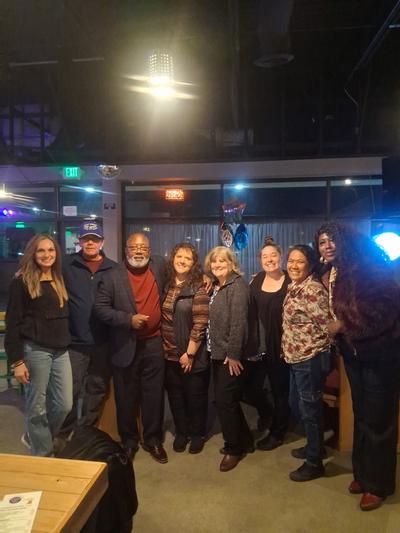
After serving four years in the Air Force, Earon Davis married in April 1969. Balancing newly married life with his pursuit of higher education, he carefully selected a position at Safeway for its flexibility, allowing him to work while attending school. On June 18, 1969, he began what would become a decadeslong career that started at the Lincoln Heights Safeway and ended as a respected leader who poured into so many community members. Starting as a checker and stocker, he worked his way into management, becoming the first Black assistant manager in Safeway’s Spokane division. He later served as first assistant manager and spent 30 years at the Lincoln Heights Safeway, where his presence became a constant in the community.
His dedication and leadership quickly set him apart. He was accepted into the Spokane division’s management program and, in July 1978, was promoted to second assistant manager, becoming the first Black assistant manager in the division. By November 1981, he advanced to first assistant manager at the Sprague and Stone location, marking a historic rise in a space where representation had been limited.
Beyond his professional achievements, his impact on the community was profound. Hiring extensively from Spokane’s East Side, he created opportunities for local youth and became a trusted and familiar presence.
His excellence did not go unnoticed. Over the course of his career, he was formally recognized by leadership at every level, from district managers to senior executives, culminating in a special luncheon honoring his exceptional service and enduring contributions to the company and community.
For 56 years, Earon Davis was more than a Safeway employee. He was a steady presence, a mentor, and a reflection of what consistency and familiarity look like in a community. Known across Spokane, especially on the South Hill and in East Central, Davis built relationships that extended far beyond the checkout line, a constant face on the East Side of Spokane.
After retiring in October 2025 to care for his wife, whom he married in 1969, and who passed away in December of that same year, Davis leaves behind a legacy rooted in people. He shares more about his journey below.
Q: Mr. Davis, can you tell me one of your best memories of working at Safeway for so many years?
Earon Davis: “Oh, the best memories are the people that I came in contact with over the years, people from all walks of life. And just the interaction with customers and some of the employees that I work with and some that work for me.
Long lasting friendships over the years. And just making people feel good about themselves, and, you know, when you meet them and you greet them, they become a part of your family.”
Q: Beyond the paycheck, what life lessons did you try to pass on, especially to young people?
Davis: “Just being being honest and being truthful, with integrity. You know, doing the best you can and seeing everybody the same way you want to be treated, fairly.
That’s what I tried to help the young people to understand, you know, be on time, be punctual. Make sure you are neat, clean. I tried to instill that in them, and some of them took it and some of them didn’t, and some of them are quite successful around Spokane.”
Davis was known not only for his work ethic but for his role as a visible Black leader in spaces where representation was limited. He modeled standards, habits, and expectations that not everyone had the opportunity to learn or see demonstrated in their early environments.
Q: Why does representation and seeing faces that look like your own matter, especially in a place like Spokane?
Davis: “Well, I feel once people see you, they see someone who looks like you, it makes them want to strive to reach whatever goals they want in life, and they give them an impression that they can do it when they see someone of their color.
Especially when they know that, you know, you not only work in that area, but you’re in the community, you see people, different things like church, ball games and stuff, they see.
And so, I think it kind of inspires, especially youth when they see someone of the same color of their skin doing something positive.”
His presence was a bridge between generations, between expectation and opportunity.
Q: Why is it important to have strong work ethic and longevity in a career?
Davis: “Well, it’s important to have a strong work ethic because I used to always tell the young people, ‘you might not like this job, but you do the best you can, be always on time, and I always give a two weeks notice so that you can have a good work history to go to something else.’
Because some of them went off to college and some of them left Spokane. So I always made a point to make them see whatever you’re doing right now is going to affect you later on in life, the choices that you make now are going to affect you later.
If you don’t like the job, you still show up on time, you do a good job, you do what is required of you, and to be, you know, and do it with integrity.
Because a lot of times they have their negative thing about people, and they still do in Spokane, that if they don’t watch it, you’re going to steal, or what have you.
But again, I’ve met a lot of good people in Spokane, so Spokane has been good to me. But you have to demand your respect and you have to respect people. But you also have to draw the line that they’re not going to walk over you. You’re not like everybody else, so don’t treat, don’t go that way.”
In a city where visibility matters, Earon Davis, Sr. stood as a consistent, steady example of leadership in everyday life. His legacy is not only in the years he gave, but in the people who now carry forward what he poured into them.
And if you ever asked him how he was doing, you already know the answer: “Just Marvelous.”