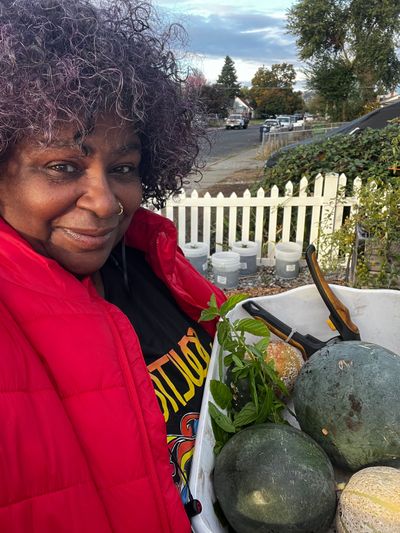
As part of Earth Month, community advocate Duaa-Rahemaah Hunter is helping organize Black Earth Day: Seed to Soul, an event focused on environmental justice, food access, land stewardship, and community healing through gardening. Hunter spoke about the inspiration behind the event and why reconnecting with the land matters for Black communities.
Q: What is coming up in April? Can you explain it?
Hunter: Oh my gosh. So it’s the Black Earth Day Seed to Soul celebration. So what it is is to recognize the environmental influence justice in the Black community regarding pollution, food. It also land, land stewardship and the disparities around all that.
Q: Why is this important for this specific recognition and the way you are recognizing it? What is your hope or goal?
Hunter: The reason why I feel this is important is that, as you know, I work in housing, right? But I started gardening in my yard a couple of years ago and made my yard a community garden because I give back what I do know.
When they do build housing for the Black communities, in communities of color and people with low income, it’s always in a place where there’s food deserts, around a lot of factories, which put pollution into that community.
Hunter explains that her interest in gardening grew out of both her professional work in housing and her desire to create spaces where people can reconnect with the land. She said gardening is not only about growing food but also about creating opportunities for people to build skills, share knowledge, and strengthen community relationships.
She reflected on early conversations during the planning stages of the Carl Maxey Center, when Sandy Williams first purchased the building and it was still just a garage. Community members gathered there imagining what the space could become. Hunter often joked during those early meetings that wherever she worked, she knew one thing for certain. One day she would have a corner office in that building overlooking a garden and water fountain. Today, she says, seeing the garden outside her window reminds her how powerful it can be when communities dream collectively about what is possible. She continues below.
Q: It sounds like this is about more than just gardening.
Hunter: Every time I look at my window and see my garden, I always think of that conversation I had with Sandy and others in that room. I got a garden, and how it’s therapeutic to put your hands in the soil and to just see the fruits of your labor.
I see things coming back. I’m not a master gardener, but it’s about bringing people together and food.
Like from the seed to the soul, S-O-U-L, the soul, the seed to the soul.
Hunter also pointed to the quality and accessibility of food in many neighborhoods. She noted that produce purchased at some grocery stores often does not stay fresh for long, which highlights deeper issues related to food access and distribution. For her, community gardening offers a different path. Growing food locally allows people to harvest something fresh from their own yard or a shared garden space, while also creating a sense of pride, ownership, and connection among neighbors.
Q: What can people expect from the event on April 18th at the MLK Center?
Hunter: So since we’re doing the event in the historical Black neighborhood of Spokane, in the East Central, it’ll be a really great event.
We’ll have information, interactive activities for the kids to make sustainable and recyclable items.
There will be some giveaways. There’ll be information around environmental justice and how people can get involved in their community.
We’ll have elected officials come speak. We’ll have music. It’s gonna be like a reunion. We’ll have food.
Everything is paid for, nobody has to pay for anything. They’ll come in, they’ll get three tickets and out of the food places there they’ll be able to get items.
We’ll have box water because it’s an environmental justice piece and it’s about saving the earth as part of Earth Day.
So we want to be mindful about that. We’ll have the city of Spokane emergency preparedness, especially around climate and environmental issues around smoke and wildfires and what to do.
People will be giving out compost so people can learn how to compost at home. Instead of throwing all that food into the garbage it’s learning how to use that food to regrow things.
And seeds. We’ll have where kids can make little starter plants and stuff like that. So I’m super excited.
We’re also going to be asking people to bring a non-perishable item to the Martin Luther King Center food bank so people can also donate to that food bank.
Q: What do you see as one of the biggest environmental justice issues affecting Black communities right now?
Hunter: I would say right now if we’re looking at land stewardship, you know that we don’t get treated like those who don’t look like us around being able to get land to farm or get free land from the city or the state like that to do community gardens.
It’s knowledge, what we don’t know.
I’m not a master gardener. I Google and I ask questions, right?
There’s also where they put us, where they build housing and food deserts in certain neighborhoods.
If you really look right now you can tell where there’s money and where it’s not, because in most places if you look outside your neighborhood and do you have trees keeping you shaded in your neighborhood.
Because if not then you use more electricity when it’s really hot.
And then when you go into certain neighborhoods of money there’s big trees just covering the whole block, right?
You know, so things that we don’t notice that we notice.
Q: You also mentioned learning and building knowledge collectively.
Hunter: Exactly. Because I’m getting ready to go this weekend to an urban homesteading expo to learn more and get ideas.
For me it’s not just about what’s in my yard.
It’s like I’ve been talking to the city, to WSDOT, about land.
How do we make community gardens in food deserts?
Where are our farmers markets located?
So it’s even thinking about how we open up our opportunities.
What I’m really trying to do is get a collective.
I’ve been talking to Black farmers and thinking about all this agricultural land that we have here.
It’s like what can we do? So I’m going to do something about it.
Q: Is there anything else people should know about the work happening around Black Earth Day?
Hunter: Yes.
The weekend before on April 11 from one to three at the Carl Maxey Center we’re showing environmental and food justice films and having a community conversation about what we can do together.
One of them is called Riddle which talks about how they we’re trying to dump some toxin into one neighborhood and they stopped them and made a green space and then a farm to table.
And then the other one is about Black folks in Detroit who started gardening and created their own co-op with a hall and a kitchen that they rented out for the community that sustained that.
That’s something that we can do in the community.
This is all my heart and it’s my passion right now because every time I look at them it’s like we can do more.
And when I’m working with folks and referring them to other folks that don’t look like us it’s like yeah we need something for us.
We gotta do this for us.