It matters where we spend our money. Mom turned 102 last month. Her previous birthdays have been really big affairs. This year she insisted we tone it down a bit. Given her insistence, we decided to stay home and keep it to just family with a few added friends. We also decided to let someone else cook it.
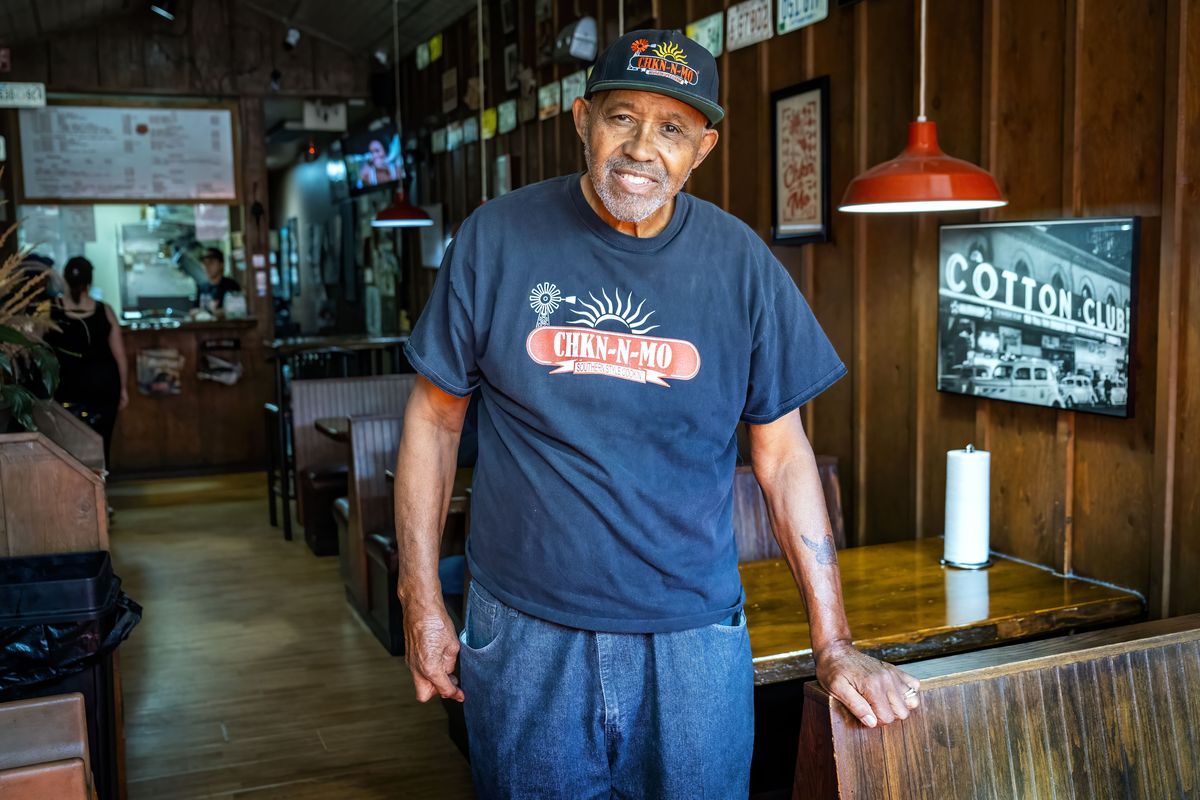
Mom loves fried oysters but her second favorites are catfish, fried chicken with greens. Years ago, I took her to Chicken-N-Mo for lunch. Owner Bob Hemphill was cooking that day so I introduced him to mom and we had a little visit at our booth. Since then, we have tried to go back as often as we could. As the years passed and mom’s mobility began to fade it became harder to get her there. She now needs a walker and sometimes a wheelchair when going out. Bob’s space is a little cramped and going downtown is one of my least favorite things to do.
Many folks don’t consider Spokane to be much of a city, but I do. Over time I have studied the early Black history of this city and consider myself blessed to have a few Black friends, roughly my age, who were born and raised here.
They tell me that at one time Black folks had good reasons to go downtown. There were a few Black owned businesses and night spots in or near the heart of the city. There were other places where Black folks worked and Black bands entertained; however, places like the Spokane Club and the Davenport Hotel were not always welcomed. Spokane has come a long way since then, but Black owned businesses in the heart of the city have not.
I would make more of an effort to support Black owned businesses downtown if there were any. This is not just a Spokane thing. Many much larger cities with significant Black populations and Black neighborhoods don’t have many either.
I just finished reading a 2012 book written on the subject of the scarcity of Black-owned businesses titled, “Our Black Year: One family’s quest to buy Black in a racially divided economy,” written by Maggie Anderson. Maggie is CEO and cofounder, along with her husband John, of the Empowerment Experiment and the Empowerment Experiment Foundation. They are both very well-to-do Black professionals who live in an upscale, diverse neighborhood in Chicago. They decided to dedicate a full year to buying everything they could possibly buy—from soup to nuts—from Black owned businesses in and around the Windy City.
Maggie describes her disappointment that, even in one of America’s Blackest cities and in the Blackest of neighborhoods in that city, there are “food deserts.” Food deserts are urban places or neighborhoods with few decent food or buying options. When she did find Black owned businesses, they were often in poor neighborhoods or in the least desirable parts of the city. Cities once had thriving Black owned grocery stores, banks, farmer’s markets, restaurants and Black owned night clubs. Not today. According to Maggie, Black people are partially to blame. When we do have Black owned businesses, we don’t necessarily support them. Many of us have moved up and out of the city and taken our money with us.
A Spokesman-Review article recently announced a new North Side area the “chicken lover’s paradise.” A number of chicken franchises have opened north of the Y, within close enough proximity to one another to create this “chicken paradise.” A friend of mine checked them out and marveled at each store’s offerings. He was surprised to see so many Black folks were working in them. I suspect that none of the business are Black-owned. Their location, offerings and relative convenience—with plenty of free parking—are good news to the average consumer. Unfortunately, they are contributing to the death of downtown and specifically to the death of our only Black owned, mom and pop chicken/catfish business.
I drove downtown to personally place mom’s birthday order from Chicken-N-Mo. I took the Division Street exit, then traveled north to Sprague and turned west. There was an empty parking spot at a meter on North Washington Street and I took it. As soon as I crossed the street, I encountered 10 to 15 folks standing or sitting on the sidewalk leading to Chicken-N-Mo. They weren’t there for the chicken. A few looked as if they had spent the night on that sidewalk. I cautiously made my way without incident, stepped inside the familiar space and walked straight to the counter. Bob happened to be there which was nice. We had a chance to visit as we always do and as always, he asked about my mother.
I placed the order and we arranged a time for me to pick it up a few days later. On Saturday afternoon I returned. While I was waiting at the counter the store phone rang. It was Bob calling to make share my order was ready—it was. I paid and left the restaurant with a huge smile of gratitude on my face. Spending my money there is about more than the food–it’s about relationships.
By the time I made it back to I-90 to head home I wondered just how much longer the only Black-owned, mom-and-pop chicken/catfish establishment in the city of Spokane can last. Even though I have my issues with going downtown, I can’t imagine Chicken-N-Mo not being there. Besides, I doubt seriously if any out-of-town chicken franchise owner anywhere would ask me about my mother.
It’s also interesting to think about the role segregation played in the establishment and growth of Black-owned businesses in the heart of the city. Where we spend our hard-earned dollars is a value statement–it matters!
Dr. Bartlett is a retired educator. He retired from Gonzaga University in 2007 and Eastern Washington University in 2020.